- Generalist paradox: Operations is too broad, so a generic headline makes you invisible in recruiter searches.
- Recruiter psychology: Reduce cognitive load with specificity, lower risk with proof signals, and trigger authority with outcomes not tasks.
- OVP framework: Build headlines using Operational scope plus Value driver plus Proof to turn a title into a CEO-level value pitch.
- Keyword translation: Match the sector language (Supply chain, Manufacturing, BizOps) so you show up for real pain keywords, not “Operations.”
- Audit and avoid: Skip fluff and desperation, use clean separators, front-load what shows on mobile, and include hard keywords plus metrics.
The Strategic Imperative: Why Your Headline is Your CEO Pitch
In the ruthless ecosystem of corporate hierarchy, the Operations Manager occupies a paradoxical space. You are the engine of the enterprise – the architect of efficiency, the guardian of margins, and the executor of strategy. Yet, in the digital marketplace of talent, specifically on LinkedIn, operations professionals suffer from a chronic visibility crisis. This is what we call the “Generalist Paradox.”
Here is the brutal reality: “Operations” is the most ambiguous term in business. To a tech startup, it means revenue operations and scaling SaaS tools. To a manufacturing giant, it means Lean Six Sigma, supply chain resilience, and union negotiations. To a retailer, it means inventory turns and loss prevention. If your LinkedIn headline for operations manager roles merely states “Operations Manager at Company X,” you are effectively invisible.
Why? Because executive recruiters and hiring managers do not search for “generalists.” They search for specific painkillers to their acute business headaches. They are hunting for “Supply Chain Optimization,” “Cost Reduction,” “Change Management,” or “ERP Implementation.” A generic headline forces them to dig through your profile to guess your value – a task they simply will not do in the 6-second window they allocate to screening candidates.
This pillar page is not just a collection of templates. It is a strategic manifesto for redefining your personal brand. We will dissect the psychology of decision-makers, provide you with high-level frameworks used by C-Suite executives, and hand you the exact tactical scripts to transform your headline from a job title into a compelling value proposition that commands authority and drives high-value conversations.
The Psychology of Executive Recruiting: Decoding the Decision Maker

To craft a headline that converts, you must first empathize with the person sitting on the other side of the screen. Understanding the psychological triggers of recruiters and VPs of Operations is the difference between being ignored and being headhunted.
1. The Cognitive Load Filter
Imagine a recruiter’s dashboard. They are inundated with hundreds of profiles daily. Their brain is actively looking for reasons to exclude candidates to save mental energy. This is known as “Cognitive Load Theory.” If your headline is vague (“Passionate Operations Leader”), you force their brain to work harder to categorize you. The brain resists this effort and moves to the next profile.
👉 The Fix: Specificity is the antidote to cognitive load. When you write “FMCG Supply Chain Director,” the recruiter’s brain instantly categorizes you correctly. You have reduced their mental friction, making you easier to “buy.”
2. The Risk Mitigation Instinct
Operations is a high-stakes function. A bad sales hire misses a quota; a bad operations hire can disrupt a global supply chain, cause safety violations, or bleed millions in EBITDA. Therefore, hiring managers are inherently risk-averse. They are not looking for “potential”; they are looking for “proof.”
👉 The Fix: Your headline must act as a risk-reduction signal. Keywords like “Six Sigma Black Belt,” “PMP,” “Turnaround Specialist,” or “$100M P&L” are not just buzzwords – they are trust signals. They tell the hiring manager, “I have done this before at a high level, and I can do it for you safely.”
3. The Authority Bias
Humans are wired to respect precision. Generalizations signal juniority; precision signals seniority. A junior employee says, “I managed logistics.” A senior leader says, “Optimized Last-Mile Logistics for 40% Cost Reduction.”
👉 The Fix: Use the language of the boardroom, not the breakroom. Shift from describing tasks (what you do) to describing outcomes (what you achieve). This triggers Authority Bias, positioning you as a peer to the leadership team rather than a subordinate.
Strategic Framework: The “O.V.P.” Formula
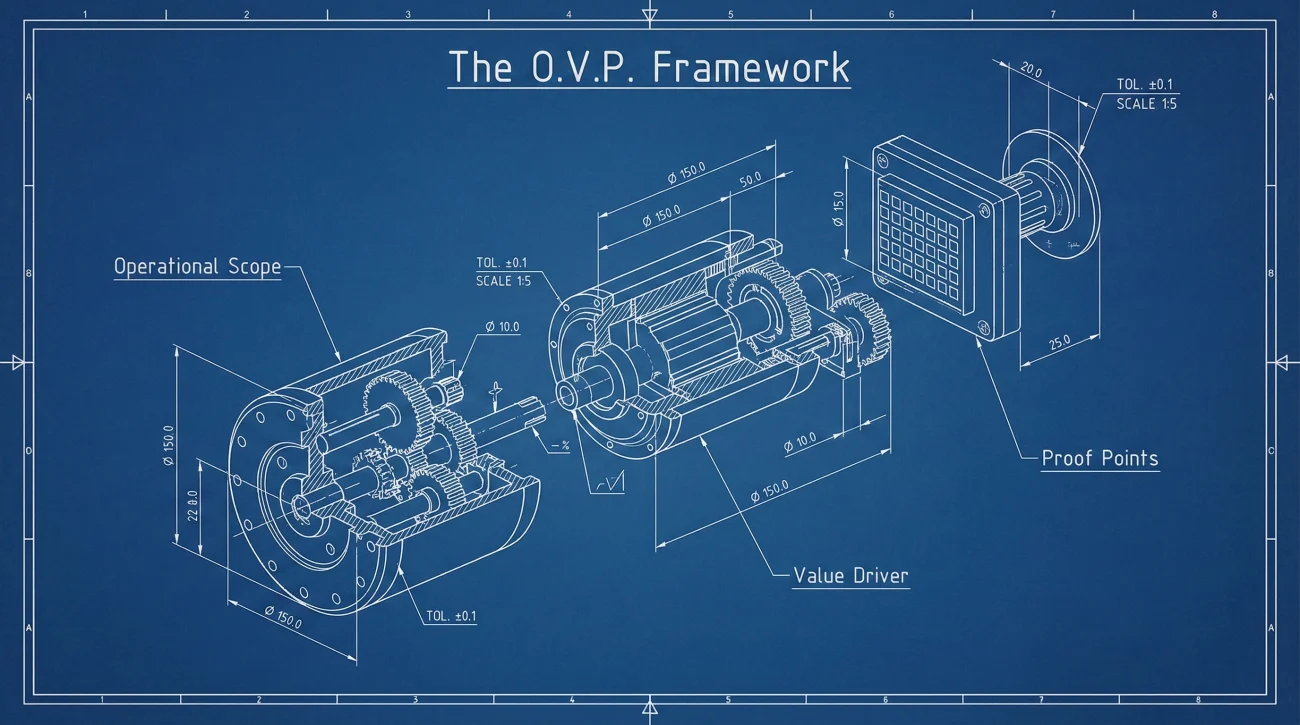
Stop guessing what to write. We have developed the O.V.P. Framework (Operational Scope + Value Driver + Proof) to help you construct a headline that hits every psychological trigger.
This is the same framework used by executive career coaches to position C-Level candidates.
Step 1: Define Your Operational Scope
This answers “Where do you play?” Be brutally specific. “Operations” is not enough.
- 🔴 Bad: Operations Manager
- 🟢 Good: Manufacturing Operations Manager
- 💯 Best: Multi-Site Plant Manager | Automotive Tier-1 Supplier
Step 2: Identify Your Value Driver
This answers “How do you win?” What is the primary metric you move? Is it Cost (COGS), Speed (Cycle Time), Quality (Defect Rate), or Growth (Scalability)?
- 🔴 Bad: Results-oriented leader
- 🟢 Good: Focused on cost reduction
- 💯 Best: Driving EBITDA Growth through Lean Transformation & Waste Reduction
Step 3: Anchor with Proof Points
This answers “Why should we trust you?” This is where hard skills and metrics come in.
- 🔴 Bad: Experienced
- 🟢 Good: 10 years experience
- 💯 Best: MBA | Six Sigma Black Belt | Managed $50M Budget
The Assembly
Combining these elements creates a magnetic narrative:
Before:
Operations Manager at ABC Corp | Hard worker looking for new challenges
After:
Global Supply Chain Director | Reducing COGS by 15% via Strategic Sourcing | $200M Spend Mgmt | Six Sigma Black Belt
Deep Dive: Supply Chain & Procurement Headlines

The Supply Chain sector has evolved from a back-office function to a strategic differentiator. In a post-pandemic world, keywords like “Resilience,” “Risk Management,” and “Sustainability” are just as important as “Cost Savings.”
Key Trend: Recruiters are currently obsessed with data visibility and digitization. If you have experience with SAP, Oracle, or AI-driven demand planning, flush it out.
Executive Level (Director/VP)
At this level, you must signal strategic vision over tactical execution.
- ℹ️ VP of Global Supply Chain | End-to-End Value Chain Strategy | Driving Digital Transformation & Sustainability | $1B+ P&L Responsibility
- ℹ️ Head of Procurement & Sourcing | Strategic Vendor Consolidation | Mitigating Global Supply Risk | Reducing TCO by 18%
- ℹ️ Director of Supply Chain Operations | Mergers & Acquisitions Integration | Network Optimization & Inventory Strategy
Managerial Level
Focus on the mechanics of optimization and specific toolsets.
- ℹ️ Supply Chain Manager | Demand Planning & S&OP Leader | Reducing Inventory Carry Costs | SAP IBP Expert
- ℹ️ Global Logistics Manager | Freight Forwarding & Customs Compliance | 3PL/4PL Management | Cost-Per-Unit Reduction
- ℹ️ Strategic Sourcing Manager | Indirect Spend & Capex | Contract Negotiation | Delivering $5M Annual Savings
Deep Dive: Manufacturing & Production Headlines
In manufacturing, the language is distinct. It is the language of physics and finance combined. You are dealing with tangible assets, unions, safety regulations (OSHA), and relentless output targets.
The “Golden Triangle” of Manufacturing Keywords:
1. Safety: “Zero Harm,” “EHS,” “OSHA 30.”
2. Quality: “ISO 9001,” “Zero Defects,” “TQM.”
3. Efficiency: “OEE,” “Lean,” “Kaizen,” “Six Sigma.”
Plant & Site Leadership
- ℹ️ Plant Manager | Automotive Manufacturing | Turning Around Underperforming Sites | Lean Six Sigma Master Black Belt
- ℹ️ Director of Manufacturing | Multi-Site Operations Leadership | Driving OEE Improvement from 65% to 85% | Union Relations
- ℹ️ Production Manager | GMP & FDA Regulated Environments | Scaling Production Capacity 2x | Continuous Improvement Champion
Process & Quality Roles
- ℹ️ Continuous Improvement Manager | Kaizen & Value Stream Mapping | Removing Bottlenecks & Waste | Operational Excellence
- ℹ️ Quality Assurance Manager | ISO 9001 Lead Auditor | Supplier Quality Management (SQM) | Reducing PPM Defects
Deep Dive: Tech & Business Operations (BizOps)

This is the newest and fastest-growing sector for operations professionals. Here, “Operations” does not mean factory floors; it means “Frictionless Growth.” The goal is to align sales, marketing, and product teams to scale revenue.
The Vocabulary Shift:
Instead of “Supply Chain,” think “Quote-to-Cash.”
Instead of “Lean Manufacturing,” think “Agile Methodology.”
Instead of “Plant Manager,” think “Chief of Staff.”
- ℹ️ Director of Business Operations (BizOps) | Scaling SaaS from Series B to IPO | Go-To-Market (GTM) Strategy & Execution
- ℹ️ Head of Revenue Operations (RevOps) | Aligning Sales, Marketing & CS | Salesforce & Tech Stack Optimization | Data Analytics
- ℹ️ Senior Operations Manager | Program Management Office (PMO) | Cross-Functional Leadership | OKR Implementation
- ℹ️ Chief of Staff to CEO | Strategic Initiatives & Board Reporting | Driving Operational Cadence | MBA
The Autopsy of a Failed Headline: Common Mistakes

Let’s analyze why certain headlines fail. Avoiding these pitfalls is just as important as knowing what to include.
| ❌ The Mistake | 🧠 The Psychological Impact | ✅ The Strategic Fix |
|---|---|---|
| “Operations Manager at [Unknown Company]” | Zero Information Scent. Unless your company is a household name (Tesla, Google), the name carries no weight. You are relying on the recruiter knowing your employer’s business model. | Focus on the Industry and Function. E.g., “FMCG Operations Manager” tells them the sector instantly. |
| “Jack of all trades / Wearing many hats” | The Generalist Trap. This signals a lack of strategic focus. It implies you do everything, but nothing well. It sounds like a support role, not a leadership role. | Reframe as “Cross-Functional Leadership.” E.g., “Bridging Product, Sales, and Support to drive efficiency.” |
| “Passionate / Motivated / Guru / Ninja” | The Subjectivity Error. These are fluff words. Everyone claims to be motivated. They are not searchable keywords and waste valuable character count. | Replace with Hard Skills. “Data-Driven,” “Certified PMP,” “Change Management Expert.” |
| “Looking for opportunities…” | The Desperation Signal. While honest, it subconsciously lowers your perceived value. High-value assets are rarely “looking”; they are “open to conversation.” | Use the “Open to Work” frame setting instead. Keep the headline focused on Value. If you must, use “Available for Interim Leadership.” |
The Authority Dictionary: Methodologies & Certifications

In the LinkedIn algorithm, certifications act as “Super Keywords.” They are binary filters – recruiters often filter searches by “PMP” or “Black Belt.” If you have them and don’t list them, you don’t exist in those search results.
Manufacturing & Supply Chain
- ✓ Six Sigma (Yellow/Green/Black/Master Belt): The gold standard for data-driven problem solving. Be specific about your belt level.
- ✓ Lean / Kaizen: Indicates a philosophy of waste reduction and continuous improvement.
- ✓ APICS Certifications (CSCP, CPIM, CLTD): These are non-negotiable for serious supply chain professionals. They signal deep theoretical knowledge.
Project & Business Management
- ✓ PMP (Project Management Professional): Universally recognized for execution capability.
- ✓ Agile / Scrum Master (CSM): Critical for operations roles in tech or software-adjacent industries.
- ✓ MBA: Still a strong signal for strategic, C-level potential and business acumen.
The 5-Minute Headline Audit Checklist
Before you hit “Save” on your profile, run your new headline through this rigorous audit. If you answer “No” to any of these, rewrite it.
1. The “So What?” Test: Does your headline explain the result of your work, not just the activity? (e.g., “Cost Reduction” vs “Managing Budgets”).
2. The Keyword Density Test: Have you included at least 3 hard keywords that a recruiter would type into a search bar?
3. The Character Count Sweet Spot: Are you utilizing the space? You have 220 characters. A 5-word headline is a wasted opportunity. Aim for 12-20 words.
4. The Separator Style: Are you using vertical bars (|) or bullets (•) to make it readable? Avoid commas; they make the text look like a run-on sentence.
5. The Mobile Check: The first 40-60 characters are what appear on mobile notifications. Put your most critical title and value proposition first.
❓ FAQ: Expert Answers to Tough Questions
💰 How can I showcase results if my company data is confidential?
🔄 I’m a generalist moving into a specialist role. How do I pivot?
📉 Is it okay to use “Cost Cutting” in my headline?
🚀 Should I include emojis in my headline?
🏭 What if my title is internal jargon like “Level 4 Manager”?
Final Thoughts: Your Headline is Your Career Compass
Your LinkedIn headline for operations manager roles is the single most important piece of real estate on the internet regarding your career. It follows you everywhere – on every comment you make, every connection request you send, and every search result list you appear in.
Do not let it be an afterthought. An optimized headline does two things: it helps the algorithm find you, and it helps the human hire you. It bridges the gap between where you are and where you want to be.
Take the formulas, keywords, and psychological principles from this guide and build a headline that does justice to the complex, difficult, and valuable work you do every day. Position yourself not just as an employee, but as an operational asset that pays for itself.
For more examples and deep dives into specific industries, explore our library of headline examples or read our masterclass on LinkedIn profile optimization.