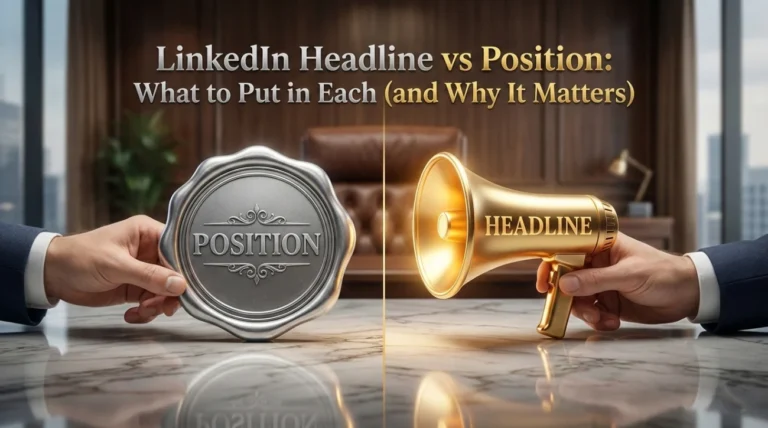
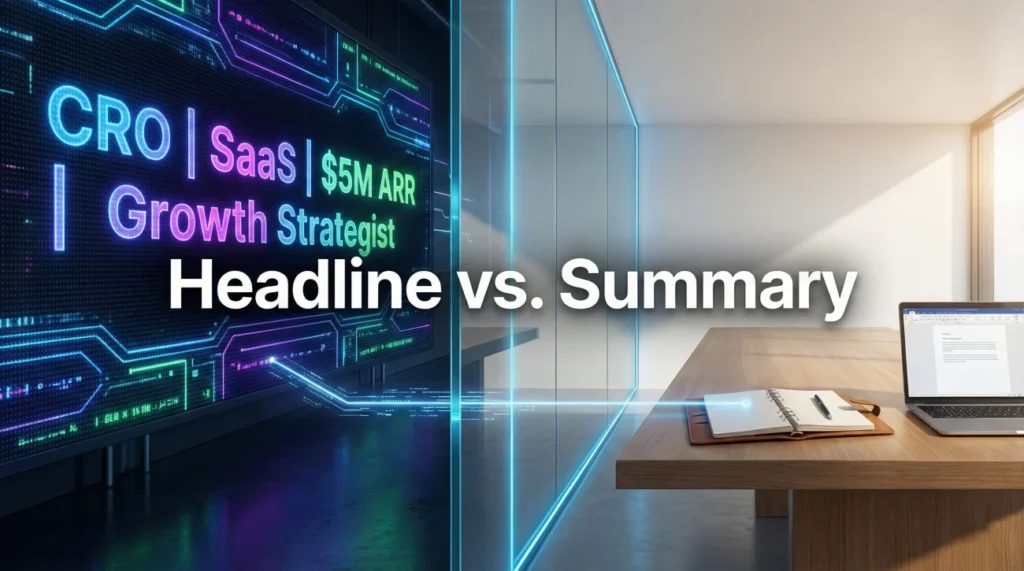
- Headline vs Summary: Headline is the billboard that wins the click, Summary is the boardroom pitch that wins the message.
- Attention mechanics: Recruiters scan in “rejection mode”, so the headline must front-load Role plus Industry plus Hard Skill inside 220 characters.
- Promise & Proof: Headline makes a bold claim, Summary supplies evidence, numbers, and narrative so the promise does not feel like clickbait.
- Mobile and SEO: Mobile truncates early, so put the anchor title first, then use exact primary keywords in the headline and related cluster terms naturally in the summary.
- Build and avoid: Use separator syntax and seniority formulas for headlines, choose a summary framework that fits your goal, and skip copy-paste, buzzwords, walls of text, and keyword stuffing.
The Billboard vs. The Boardroom: A Strategic Distinction
In the high-stakes architecture of a modern LinkedIn profile, the confusion between the Headline and the About Section (Summary) is the single most common failure point for professionals globally. Most candidates treat these two critical real estate areas as interchangeable containers for keywords, or worse, they leave the Summary blank because they believe their Headline “says enough.”
This is not just a formatting error; it is a catastrophic strategic failure. From a psychological, functional, and algorithmic perspective, these two sections operate in completely different dimensions of the recruitment funnel:
- ℹ️ The Headline is the Billboard (The 2-Second Hook): It is designed for high-speed scanning. It follows you everywhere on the platform – comments, posts, search results, and “People Also Viewed” lists. Its singular job is to generate a click.
- 🗃️ The Summary is the Boardroom (The 30-Second Pitch): It is designed for engagement and persuasion. It only appears when someone has already committed to clicking on your face. Its singular job is to generate a conversation.
To master the difference headline vs summary, you must stop thinking like a candidate filling out a passive HR form and start thinking like a Chief Marketing Officer managing a conversion funnel. The Headline is your “Top of Funnel” (Awareness/Traffic). The Summary is your “Middle of Funnel” (Consideration/Trust). This comprehensive guide will provide the master blueprint for optimizing both to work in perfect synchronization.
The Neuroscience of Attention: Why We Scan Before We Read
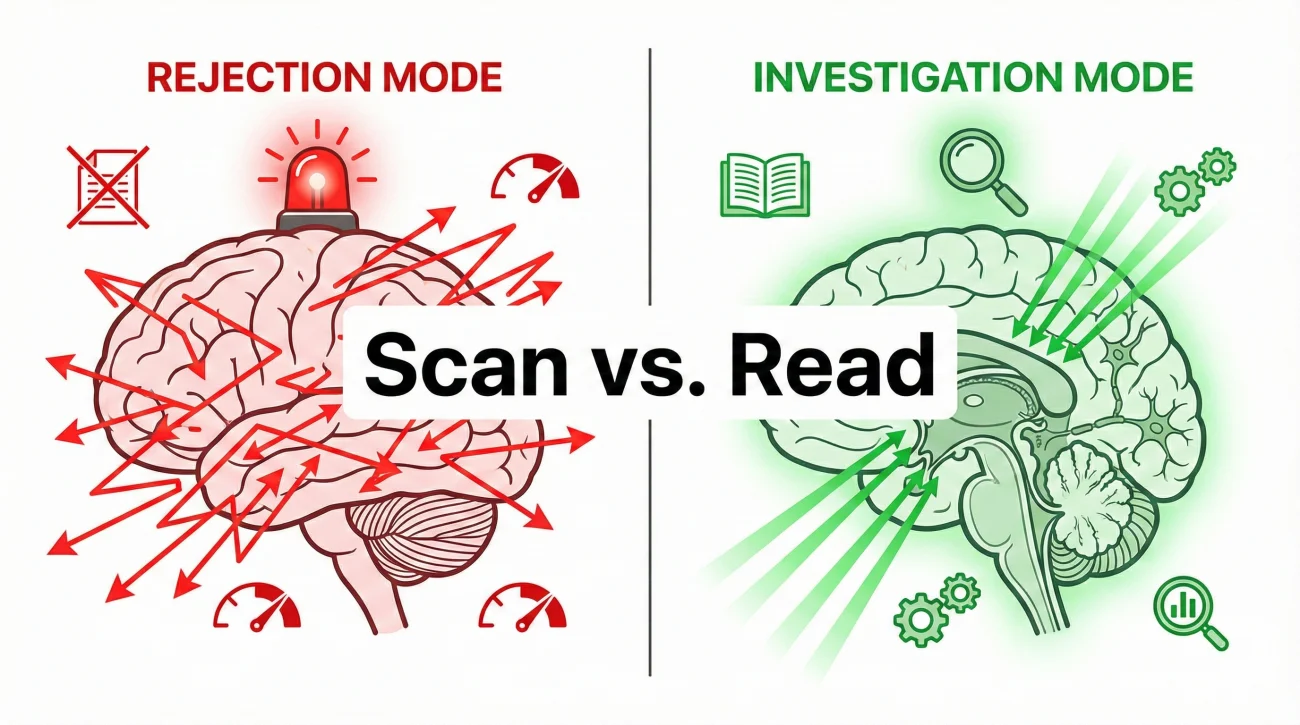
To write effectively for LinkedIn, you must first understand the biological constraints of your audience. Recruiters and hiring managers are under immense cognitive load. They view hundreds of profiles daily. Their brains are wired to conserve energy by filtering out irrelevant information instantly.
The Headline: The “Rejection Mode” Filter
When a recruiter runs a search for “Senior Product Manager,” they are presented with a list of 50 faces. At this moment, their brain is in Rejection Mode. They are looking for reasons not to click, to save time.
Your Headline has strictly 220 characters to pass the brain’s “Blink Test” (roughly 2 seconds). It must deliver hard, concrete data instantly: Role + Industry + Hard Skill. There is no room for nuance, backstory, or personality here. If the Headline is vague (“Passionate about tech”), the brain categorizes it as “Low Relevance” and skips it before conscious thought even occurs.
The Summary: The “Investigation Mode” Deep Dive
Once a recruiter clicks on your profile, their mental state shifts fundamentally from Rejection to Investigation. They have invested a “click” (a unit of effort), so now they are looking for ROI (Return on Investment). They are asking: “Is this person for real? Do they fit our culture? Can they communicate complex ideas?”
Here, the brain is willing to engage in “Deep Reading,” but only if the narrative is compelling. Bullet points and keywords are no longer enough. The Summary is the only place on LinkedIn where you can control the narrative voice. It allows you to connect the dots between your past jobs, explain career pivots, and demonstrate how you think. It validates the claim made in the Headline.
The Ultimate Comparison Matrix: Headline vs. Summary
Below is a granular analysis of the functional differences between these two prime real estate areas across five critical vectors.
| Strategic Vector | The Headline (The Hook) | The Summary (The Story) |
|---|---|---|
| Primary Objective | Searchability & Click-through Rate (CTR). To get you found by the algorithm and clicked by the human. | Conversion & Retention. To keep them on the page and compel them to send a message. |
| Visibility Scope | Ubiquitous. Visible in news feeds, comment sections, connection requests, and “People Also Viewed.” | Isolated. Only visible on your specific profile page. Requires a deliberate “See more” click to read fully. |
| SEO Weighting | Critical (Tier 1). Keywords here act as primary ranking signals. If it’s not here, you likely won’t rank for it. | High (Tier 2). Keywords here provide semantic relevance and context depth for the algorithm. |
| Optimal Tone | Objective & Punchy. Third-person style fragments. No pronouns. “Data Scientist | Python.” | Subjective & Narrative. First-person conversational. “I build models that…” |
| Key Constraints | 220 Characters. Every letter costs money. No formatting allowed. | 2,600 Characters. Visual formatting (white space, emojis, lists) is essential. |
The “Promise & Proof” Framework

The most sophisticated way to conceptualize the relationship between your Headline and Summary is the Promise & Proof Framework. This principle is borrowed from high-end direct-response copywriting and applies perfectly to personal branding.
The Headline Makes a Bold Promise
It claims a specific identity, a level of seniority, or a unique value proposition. It sets a high expectation in the reader’s mind.
Example Promise:
“Enterprise Sales Director | Closing $5M+ Deals in SaaS & Cybersecurity”
The Summary Provides the Irrefutable Proof
It delivers the evidence, the methodology, the specific data points, and the context that validates the promise. Without the proof, the headline is just clickbait.
Example Proof:
“In 2019, I took over the failing Northeast territory. By implementing the Challenger Sales methodology and restructuring the SDR team, we closed a $5.2M contract with a Fortune 500 bank – the largest in company history…”</emp
The Trust Gap: If your Headline promises “Innovation Leader” but your Summary reads like a generic, copy-pasted job description (“Responsible for managing teams”), you have broken the trust of the reader. The gap between the Promise and the Proof is where 90% of candidates lose the opportunity.
The Mobile-First Reality: Designing for the Small Screen
Over 60% of LinkedIn traffic comes from mobile devices. This technical reality drastically changes how your Headline and Summary are consumed. Ignoring this is a fatal error.
The Truncated Headline
On the desktop search results page, users might see 100+ characters of your headline. On mobile apps, this can be cut off after as few as 40-50 characters depending on the screen size and view mode (e.g., in the “People You May Know” list).
The Strategy: Front-Loading. You must place your “Anchor Title” (your actual job target) at the very beginning.
🔴 Bad: “Passionate about data and results | Data Scientist”
🟢 Good: “Data Scientist | Passionate about…”
The Hidden Summary
On mobile, the Summary is collapsed into a tiny preview showing only the first 2-3 lines of text. The user must tap “…see more” to read the rest. This creates a “Cliffhanger” dynamic.
The Strategy: The Hook. Your first sentence cannot be a boring introduction (“I am a professional…”). It must be a hook that forces a tap.
Hook Example:
“I didn’t start my career in sales; I started in engineering. That’s why I can explain complex SaaS products better than anyone else…”
Deep Dive: The Headline Strategy
Your Headline is your 220-character elevator pitch. Let’s break down the mechanics of a perfect headline.
The “Separator” Syntax
Stop writing full sentences. Sentences require “grammar words” (is, a, the, of) which waste valuable character space and lower your keyword density. Instead, use the “Separator” syntax using Vertical Bars (|) or Bullets (•).
Sentence Style (Bad): “I am a Project Manager who helps agile teams.” (40 chars, 2 keywords)
Separator Style (Good): “Project Manager | Agile Certified (CSM) | Scrum Master” (53 chars, 4 keywords)
Proven Headline Formulas by Seniority
| Level | Formula | Example |
|---|---|---|
| Entry Level | [Target Role] | [Top Hard Skills] | [Degree/Uni] | Marketing Coordinator | SEO & Google Analytics | Honours Graduate (UCLA) |
| Mid-Senior | [Current Title] | [Niche/Industry] | [Unique Value] | Senior Java Developer | Fintech & Payments | Building High-Frequency Trading Systems |
| Executive | [C-Level Title] | [Strategic Outcome] | [Scale Metric] | Chief Revenue Officer (CRO) | Scaling Series B to IPO | $0 to $100M ARR Growth |
Deep Dive: The Summary (About Section) Frameworks
The Summary is your blank canvas. However, a blank canvas can be paralyzing. Here are three distinct architectural frameworks for writing a high-converting Summary depending on your goal.
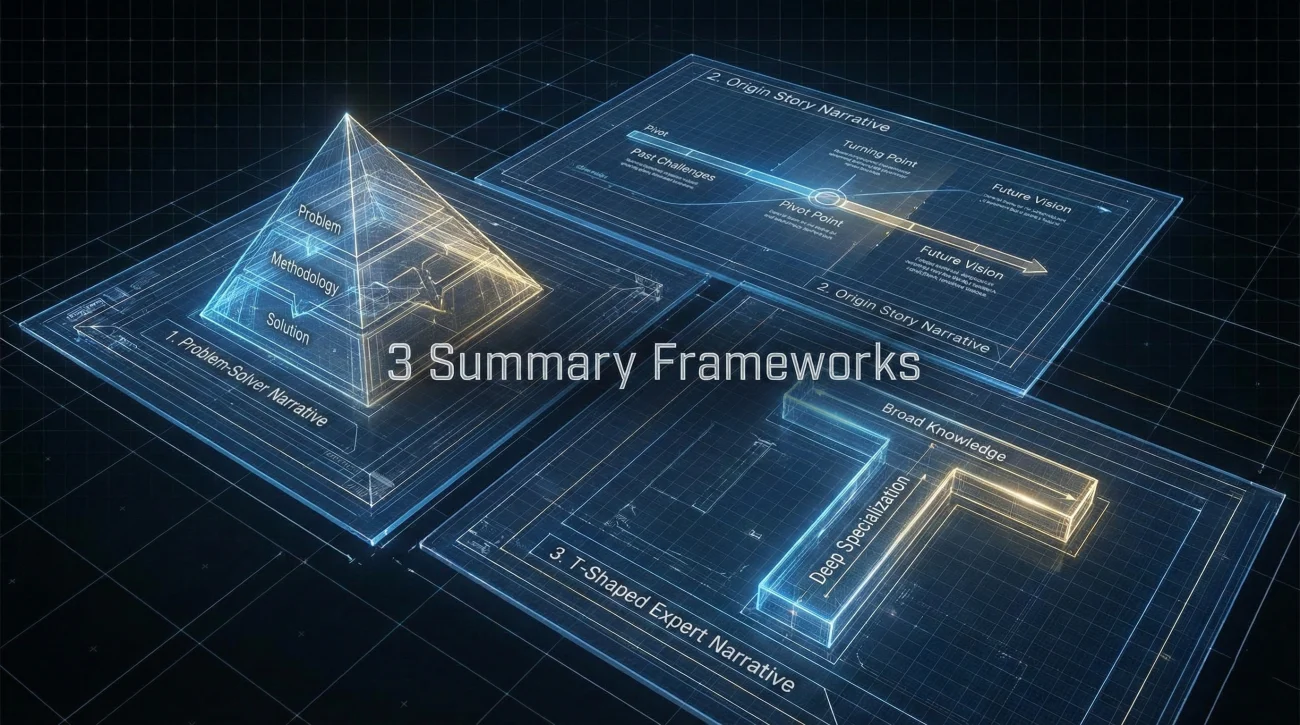
Framework 1: The “Problem-Solver” (Best for Senior Roles)
- The Hook: Identify a painful, expensive problem in your industry.
- The Agitation: Explain why this problem is hard to solve.
- The Solution: Explain how you solve it uniquely.
- The Proof: List 3 bullet points of results.
“Most SaaS companies fail because they scale sales before they find product-market fit. I fix this revenue leak…”
Framework 2: The “Origin Story” (Best for Career Pivoters)
- The Hook: Start with the pivotal moment you changed careers.
- The Bridge: Explain how your old skills transfer to the new role.
- The Current State: What you are building now.
“I spent 10 years as a classically trained musician before writing my first line of code. I quickly realized that writing a symphony and architecting a database require the exact same logic…”
Framework 3: The “T-Shaped Expert” (Best for Generalists)
- The Hook: Define your broad base.
- The Vertical: Define your deep spike of expertise.
- The Toolbox: List your hard skills matrix.
“I am a Marketing Generalist with a dangerous obsession with Technical SEO. While I can manage a 360-degree campaign, my superpower is technical site audits…”
Industry-Specific Playbooks: Context Matters
What works for a creative director will kill the credibility of a forensic accountant. You must calibrate your Headline/Summary strategy to your industry’s “Dialect.”
1️⃣ The Tech & Engineering Playbook
The Tech & Engineering Playbook
ℹ️ Headline: Must be keyword-heavy. Stack is everything. “React | Node | AWS.”
📑 Summary: Must show passion for building. Talk about side projects, GitHub repos, and specific architectural challenges you solved (“Refactoring a monolith to microservices”).
🔆 Tone: Casual, direct, meritocratic.
2️⃣ The Finance & Legal Playbook
The Finance & Legal Playbook
ℹ️ Headline: Formal titles. Credentials are currency (CFA, CPA, JD, MBA).
📑 Summary: Conservative, results-oriented, risk-averse. Focus on deal size, regulatory compliance, and accuracy.
🔆 Tone: Professional, restrained, authoritative.
3️⃣ The Creative & Design Playbook
The Creative & Design Playbook
ℹ️ Headline: Can be slightly more abstract but must still include the role. “Visual Storyteller | UX/UI Designer.”
📑 Summary: Show your process. How do you go from a blank page to a finished design? Use emojis. Use voice.
🔆 Tone: Expressive, human, distinct.
4️⃣ The Sales & Revenue Playbook
The Sales & Revenue Playbook
ℹ️ Headline: Numbers. “Account Executive | $2M Quota.”
📑 Summary: You are selling yourself. If your summary is boring, I assume your sales pitch is boring. Use short, punchy sentences. Focus on ROI.
🔆 Tone: High energy, confident, persuasive.
Advanced SEO Masterclass: Semantic Search & Keyword Density
Many “gurus” tell you to stuff keywords everywhere. This is wrong. The LinkedIn algorithm (and Google’s) uses Semantic Search – it understands context, not just text string matching.
Headline SEO: Primary Ranking Signals
If you want to rank for “Project Manager,” that exact phrase MUST be in your Headline. This tells the algorithm what you are. Synonyms (like “Team Lead”) are weaker signals here.
Summary SEO: Latent Semantic Indexing (LSI)
The algorithm scans your Summary to determine how deep your expertise is. It looks for “Cluster Keywords” – words that are naturally associated with your core role.
Example: If your Headline says “Project Manager,” the algorithm expects your Summary to contain words like: Agile, Scrum, Waterfall, Stakeholders, Budget, Risk Management, Jira, Confluence.
If your Summary lacks these cluster keywords, the algorithm downgrades your profile because it deems you a “Low-Relevance” match.
🎯 The Strategy: Don’t just list keywords. Weave them into sentences.
🔴 Bad: “Keywords: Agile, Scrum, Jira.”
🟢 Good: “I use Agile methodologies and Scrum ceremonies to manage workflows in Jira…”
The “Seven Deadly Sins” of Profile Writing
Avoid these profile-killing mistakes at all costs.
| The Sin | Why It Fails | The Fix |
|---|---|---|
| 1. The Copy-Paste | Repeating the Headline as the first line of the Summary wastes the “Hook” space. | Start the Summary with a story or a belief statement. |
| 2. The Third-Person | Writing “John is a leader…” sounds arrogant and distant. | Use “I” statements. Be human and accessible. |
| 3. The Wall of Text | 300 words without a paragraph break is unreadable on mobile. | Max 3 lines per paragraph. Use bullet points aggressively. |
| 4. The Buzzword Soup | “Visionary leader leveraging synergy…” means absolutely nothing. | Replace adjectives with data. “Led 50 people” > “Visionary.” |
| 5. The “Job Seeker” Vibe | “Looking for opportunities” in the Headline smells of desperation. | Focus on what you offer, not what you need. |
| 6. The Blank Summary | Forces the recruiter to guess your story based only on job titles. | Write at least 200 words connecting your career dots. |
| 7. The Keyword Stuffing | Listing “Marketing, Marketing, Marketing” looks like spam. | Use keywords naturally in context. |
❓ Ultimate FAQ: Nuances of Headline vs. Summary
📏 Is it better to have a short Summary or a long one?
🤖 Can I use AI (ChatGPT/Claude) to write my Summary?
🔄 Which section should I update more often?
📢 Should I use emojis in my Headline or Summary?
In the Headline: Use caution. One or two are fine for creative roles, but for formal industries (Law, Finance), they can look unprofessional. Never use them to replace words.
🛑 What if I have a career gap? Where do I explain it?
Final Thoughts: The Symphony of Your Profile
The difference headline vs summary is not just technical; it is the difference between a handshake and a conversation. The Headline gets you in the door; the Summary gets you a seat at the table. They are the Yin and Yang of your digital identity.
Do not neglect one for the other. A great Headline with a blank Summary makes you look like a bot or a spammer. A great Summary with a weak Headline means no one will ever find you to read it because you failed the “Blink Test.”
Take the time today to audit your profile. Does your Headline promise something exciting? Does your Summary prove you can deliver it? When these two elements align, you stop being just another profile in the database and start becoming a compelling, three-dimensional candidate that companies fight to hire.
For more deep dives into optimizing every inch of your profile, including detailed templates and copy-paste scripts, explore our comprehensive headline guide.
For more examples and swipeable headline ideas, head over to the blog.