- Main warning: One-click LinkedIn headline generators usually average you out into bland buzzwords that recruiters ignore.
- Why AI feels “off”: It lacks edge, invents passion, and misses the reader context, so it triggers a human spam filter.
- Tool reality check: Raw engines can work with strict constraints, wrappers help brainstorming, and career-platform generators often sound desperate.
- Best workflow: Use AI for volume, then human-select the best fragments, rewrite for clarity, and validate by reading it out loud.
- Do not do this: Avoid inflated verbs, keyword stuffing, vague promises, and anything that sounds like confidential-number flexing.
The Algorithmic Mirage: Why “One-Click” Branding Fails
In the explosive era of generative AI, the allure of the LinkedIn headline generator is undeniable. It promises a frictionless solution to a high-stakes problem: defining your professional value in 220 characters. The logic seems sound – if AI can pass the Bar Exam and code in Python, surely it can write a headline for a Project Manager.
However, after testing the market’s leading tools against thousands of real-world profiles, a stark reality emerges. Most AI generators operate on a model of “Average Probabilistic Output.” They predict the most likely next word based on millions of generic profiles scraped from the web. The result? They don’t make you stand out; they aggressively regress you to the mean.
They turn unique professionals into “Passionate Innovators,” “Strategic Visionaries,” and “Synergistic Leaders” – the very semantic noise that sophisticated recruiters have trained their brains to filter out. Using raw AI output is the digital equivalent of showing up to an interview in a beige suit: you fit in, but you are instantly forgettable.
This guide is not merely a software review. It is a strategic manifesto on how to wield AI as a scalpel, not a sledgehammer. We will dissect the psychology behind why AI struggles with personal branding, review the major tools with brutal honesty, and provide you with the “Cyborg Framework” – a method to combine algorithmic speed with human strategic depth.
If you are looking for the fundamental principles of headline writing before diving into tools, start with our master guide on crafting the perfect LinkedIn headline.
The “Uncanny Valley” of Personal Branding
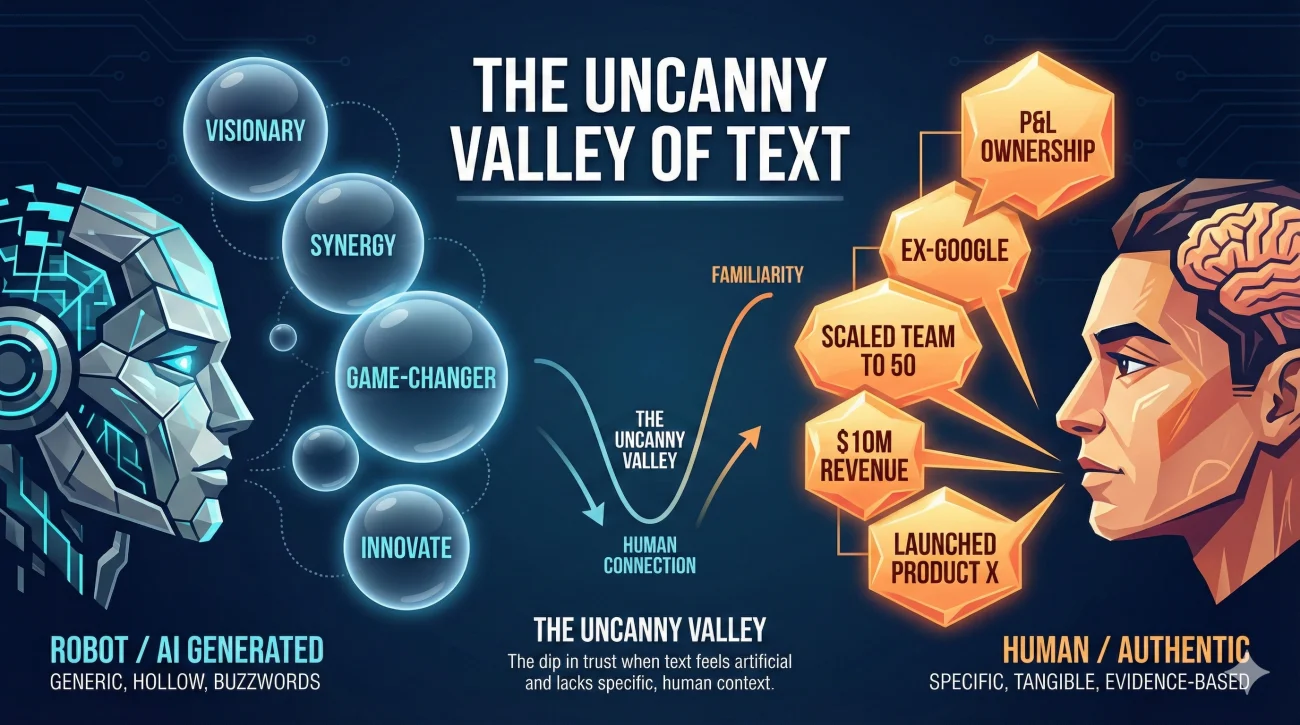
In robotics, the “Uncanny Valley” refers to the feeling of unease people experience when a robot looks almost human but not quite. The same phenomenon exists in text. Recruiters can smell AI-generated copy from a mile away. Why?
1. The Lack of “Edge”
Great personal branding requires a point of view. It requires risk. AI models are trained to be safe and agreeable. They will never write a headline that challenges the status quo or takes a bold stance, which is often exactly what is needed to capture attention in a saturated market.
2. Hallucinated Passion
AI doesn’t have feelings, yet it loves to use emotional words. It overcompensates by using adverbs.
- Human: “I manage sales teams.”
- AI: “Passionately orchestrating world-class sales synergies to drive unparalleled growth.”
This hyperbole triggers a “Spam Filter” in the human brain.
3. Context Blindness
AI lacks “Theory of Mind.” It does not understand who is reading your profile. It doesn’t know that a recruiter at a scrappy Series B startup hates the word “Visionary,” while a corporate HR director at a Fortune 500 might tolerate it. It generates content in a strategic vacuum.
The Tool Audit: Promises vs. Performance
We stress-tested five popular headline generation methods using identical “Mid-Senior” profiles to benchmark their performance. The results reveal a landscape of hit-or-miss utility.
1. ChatGPT / Claude (The Raw Engines)
The Reality: These are the most powerful tools on the list, but out of the box, they are buzzword factories. Without strict constraints, they default to flowery, empty prose. They require “Prompt Engineering” to be useful.
| Pros | Cons |
|---|---|
| ✅ Infinite iterability (you can argue with it). | ❌ Defaults to “Passionate/Innovative” clichés. |
| ✅ Understands complex career pivots. | ❌ Requires you to act as an editor. |
🎯 Verdict: The best tool for the sophisticated user who knows how to script the output.
2. Specialized Wrappers (Copy.ai, Jasper, Simplified)
The Reality: These tools wrap GPT-like models in a pretty user interface (UI). They are easier to use but offer less control. They often force you into a “Mad Libs” style structure that limits creativity.
| Pros | Cons |
|---|---|
| ✅ Zero learning curve (fill in the blanks). | ❌ Rigid output templates. |
| ✅ Often integrated with other branding tools. | ❌ “One-size-fits-all” tone. |
🎯 Verdict: Good for breaking writer’s block, bad for final drafts.
3. Career Platform Generators (Resume.io, Teal, etc.)
The Reality: Often the weakest of the bunch. These free tools are typically lead magnets designed to capture emails, not to produce high-level copy. They tend to generate headlines that sound like objective statements from a 1990s resume or desperate pleas for work.
| Pros | Cons |
|---|---|
| ✅ Fast and free. | ❌ Often sound desperate (“Seeking opportunities”). |
🎯 Verdict: Avoid if you are targeting senior or executive roles.
Prompt Engineering Masterclass: Taming the Beast
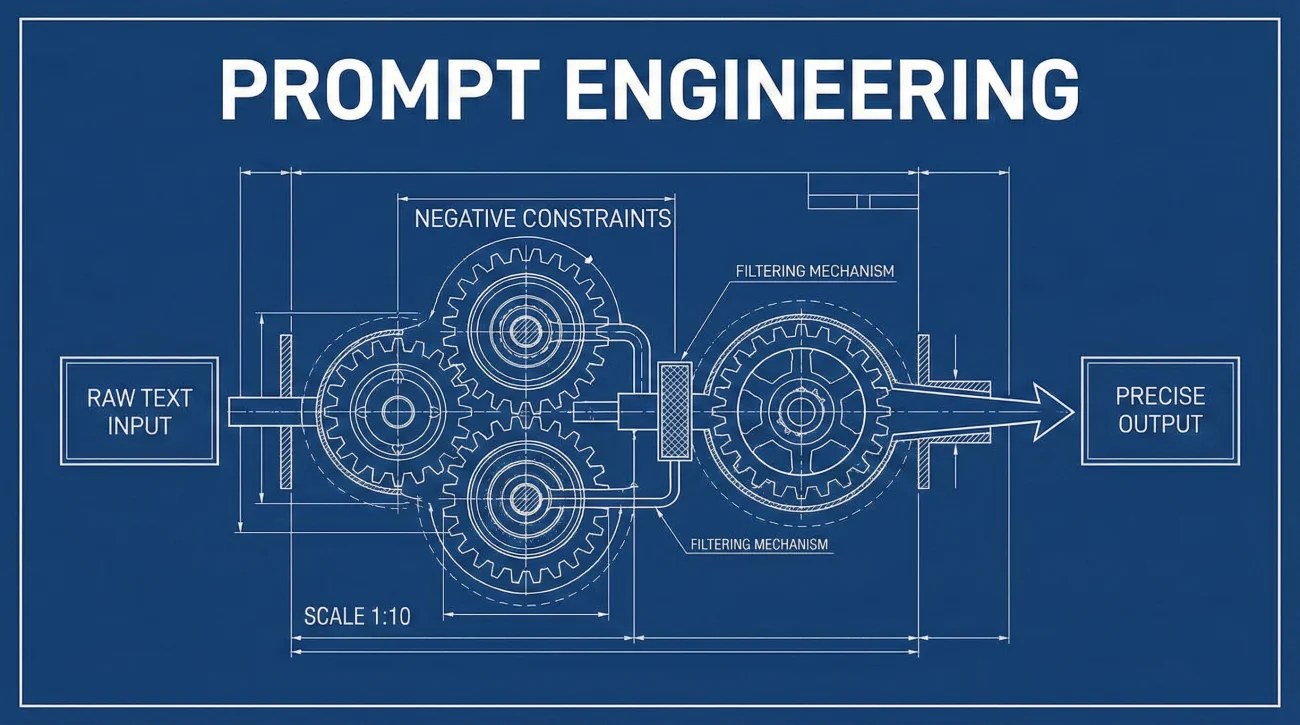
If you use a ChatGPT prompt for LinkedIn headline generation, the magic is not in the model; it is in the instructions. You must move from “Asking” to “Commanding.”
The “Negative Constraint” Framework
Most people ask AI what to do. To get great results, you must tell it what not to do. This is called “Negative Constraint Prompting.”
❌ The Rookie Prompt:
"Write a professional LinkedIn headline for a Project Manager with 5 years of experience."

✅ The Expert Prompt:
"Act as a strict Executive Recruiter for a Fortune 500 tech company. Write 10 LinkedIn headline options for a Senior Project Manager.

CRITICAL CONSTRAINTS:
1. Do NOT use the words: passionate, visionary, guru, ninja, dedicated, hardworking, synergy, unleashing, transforming.
2. Do NOT use full sentences.
3. Use the pipe symbol (|) as a separator.
4. Front-load the job title.
5. Include hard skills: Agile, Jira, Risk Management.
6. Tone: Clinical, objective, expensive, and high-status.
7. Optimize for SEO keywords."
💡 Why this works: You have stripped the AI of its default tendency to be “creative” (which usually means “fluffy”) and forced it to be “structural.” You have defined the “Persona” (Executive Recruiter) and the “Anti-Persona” (Ninja/Guru).
The “Cyborg” Strategy: Human Strategy + AI Speed
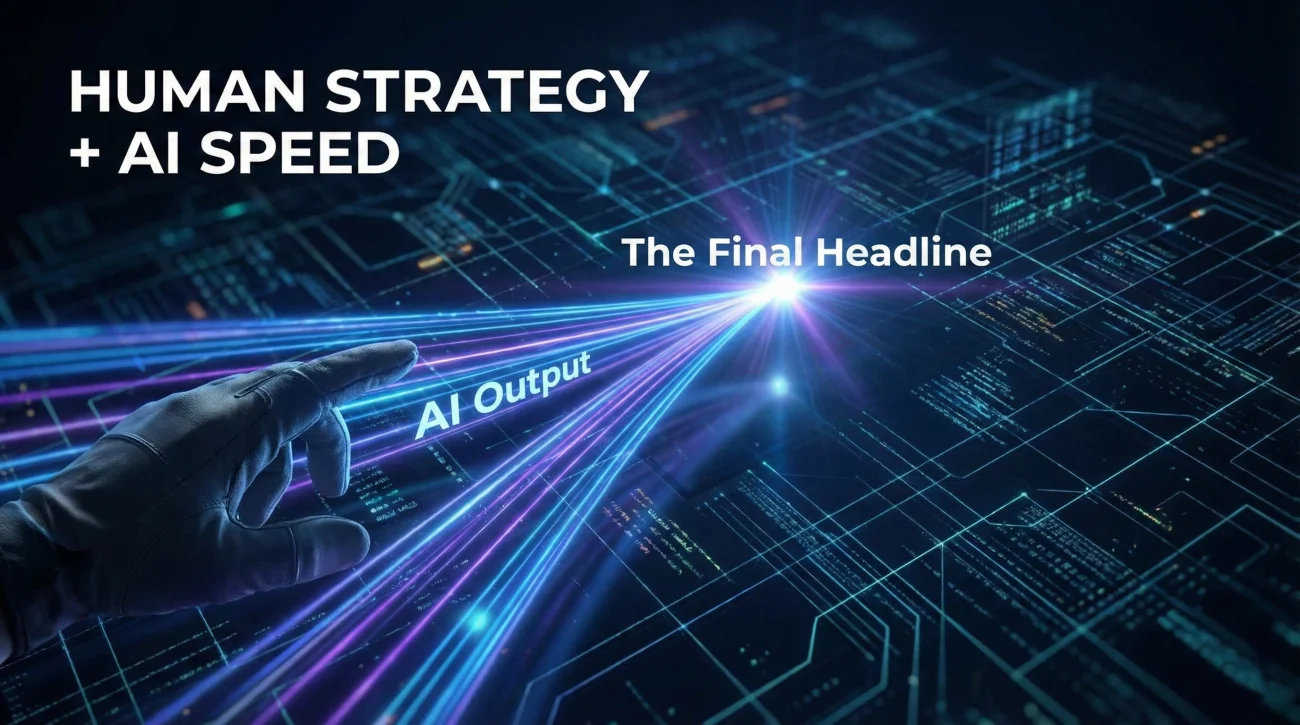
The best AI headline tool is actually a workflow, not a piece of software. We call this the Cyborg Strategy. It uses AI for volume and humans for precision.
Phase 1: The Divergent Phase (AI)
Use AI to generate volume. Ask for 20 variations. Ask for “wildly different” tones.
“Give me 5 headlines that are conservative, 5 that are aggressive, 5 that focus purely on metrics, and 5 that focus on soft skills.”
Phase 2: The Selection Phase (Human)
Read the list. Your brain will instantly recognize snippets that work. Maybe the AI phrased your metrics well in Option 3 but nailed your title in Option 12. Copy the best fragments into a notepad. Do not use any headline verbatim.
Phase 3: The Convergence Phase (Human)
This is where you apply the “Recruiter Filter.” Assemble the fragments into a coherent whole. Remove the robot-speak.
AI Output: “Maximizing Operational Efficiency through Strategic Workflows”
Human Edit: “Operations Manager | Efficiency & Workflow Optimization”
Phase 4: The Validation Phase (Human)
Read it out loud. Does it sound like something a human being would say at a networking event? If you feel embarrassed saying it, delete it.
Sector-Specific AI Playbooks
Different industries require different prompting strategies. One size does not fit all.
1️⃣ For Technology & Engineering
For Technology & Engineering
🚫 The Trap: AI tries to make code sound poetic (“Weaving digital tapestries”).
🆗 The Prompt Fix: “Focus strictly on the Tech Stack. List languages and frameworks. Prioritize ‘Senior’ or ‘Lead’ titles. No adjectives.”
2️⃣ For Sales & Marketing
For Sales & Marketing
🚫 The Trap: AI sounds like a snake-oil salesman (“Exploding revenue,” “Skyrocketing growth”).
🆗 The Prompt Fix: “Focus on concrete numbers ($M revenue, % growth). Use verbs like ‘Scaling,’ ‘Closing,’ ‘Managing.’ Avoid ‘Helping’ or ‘Empowering’.”
3️⃣ For Creative & Design
For Creative & Design
🚫 The Trap: AI sounds corporate and boring.
🆗 The Prompt Fix: “Use a playful tone. Use emojis 🎨. Focus on ‘Visual Storytelling’ and ‘Brand Identity’. Mention tools like Figma and Adobe CC.”
4️⃣ For C-Suite & Executives
For C-Suite & Executives
🚫 The Trap: AI sounds like a junior employee trying to impress.
🆗 The Prompt Fix: “Tone must be ‘Understated Authority.’ Focus on P&L responsibility, M&A, IPOs, and Board Relations. Brevity is power.”
Case Studies: AI Hallucinations vs. Human Corrections
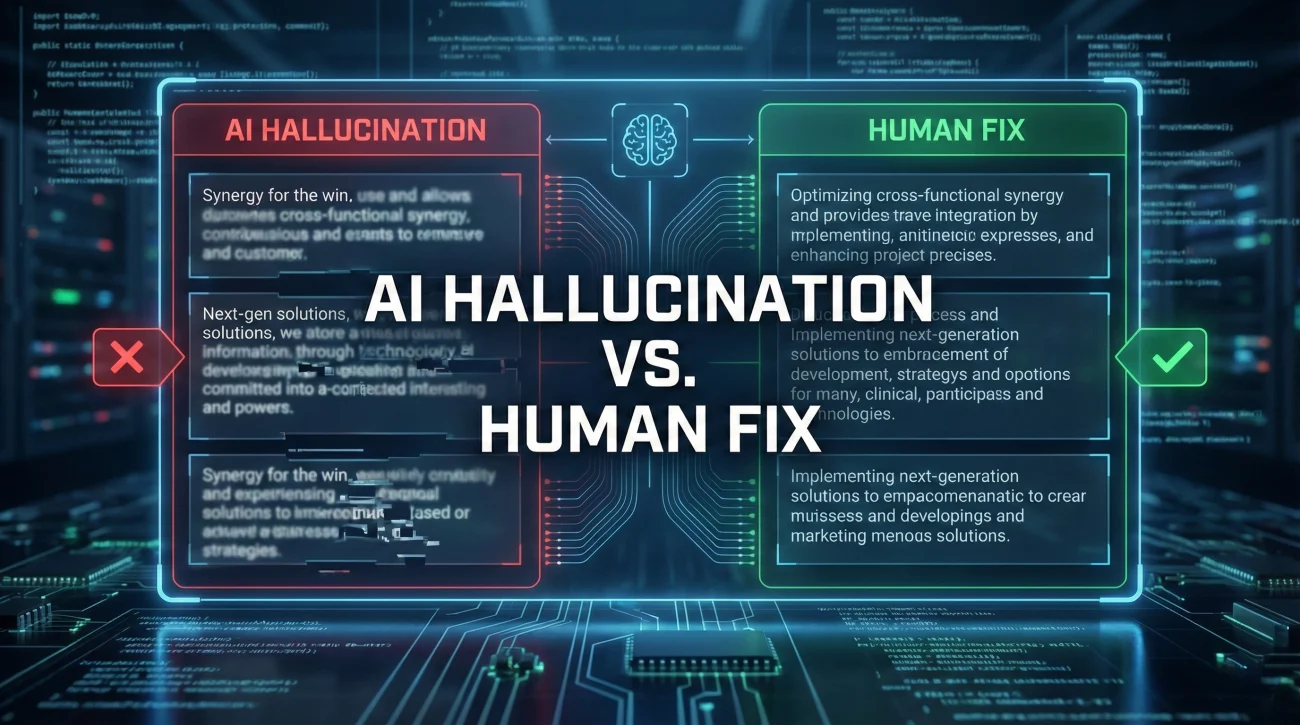
Let’s look at real examples of what happens when you trust the algorithm blindly versus when you intervene.
Case Study 1: The Mid-Level Engineer
| The AI Output (Default) | The Strategic Problem | The Human Correction |
|---|---|---|
| “Innovative Python Coder | Breathing Life into Code | Passionate about Tech” | “Breathing life” is poetic nonsense. Recruiters search for stacks, not poetry. | “Senior Python Engineer | Django & Flask | API Architecture | Ex-Fintech” |
Case Study 2: The Marketing Manager
| The AI Output (Default) | The Strategic Problem | The Human Correction |
|---|---|---|
| “Marketing Guru 🚀 | Helping Brands Explode 💥 | Storyteller” | “Guru” and “Explode” trigger spam filters in the human brain. Too informal. | “B2B Marketing Manager | Demand Generation & ABM | Scaling SaaS from Series A to B” |
Case Study 3: The Recent Grad
| The AI Output (Default) | The Strategic Problem | The Human Correction |
|---|---|---|
| “Aspiring Professional | Seeking Opportunities to Learn and Grow | Hard Worker” | Signals desperation and lack of value. Makes the candidate a burden to train. | “Honours Graduate (Finance) | Financial Modeling & Data Analysis | Python & SQL Certified” |
Common Mistakes When Using Generators
Even with the best prompts, users fall into specific traps when using these tools.
- 🚫 The “Vocabulary Inflation” Trap: AI loves big words like “Spearheading,” “Orchestrating,” and “Revolutionizing.” If you are a junior employee, these words make you look delusional. Downgrade them to “Managing,” “Leading,” and “Improving.”
- 🚫 The “Keyword Stuffing” Trap: Some SEO-focused generators will tell you to cram 20 keywords into the headline. This makes you unreadable. Stick to the “Value Stack” rule: Title + Niche + Top Skill.
- 🚫 The “Generic Promise” Trap: Headlines like “Helping companies grow” are technically accurate but strategically useless. Everyone helps companies grow. Be specific: “Helping SaaS companies reduce churn.”
- 🚫 The “Format Hallucination” Trap: AI often forgets the character limit. Always check the length. If it’s over 220 characters, it will get cut off awkwardly.
Final Thoughts: The Tool Is Not the Craftsman
The LinkedIn headline generator is a hammer. In the hands of a master carpenter, it builds a house. In the hands of a toddler, it breaks a window. The danger of AI is that it makes “average” easier to achieve than ever before, but it makes “exceptional” harder to distinguish.
Use AI to bypass the fear of the blank page. Use it to generate syntax variations you hadn’t considered. But never, ever let it have the final say on your personal brand. That belongs to you.
If you want to see what fully polished, human-curated headlines look like across different industries, explore our library of industry-specific examples.
Don’t stop at just one headline fix. The blog is packed with more scripts, templates, and ideas you can copy.