
- Core reality: LinkedIn is a search engine first, so your headline is primary metadata and bad choices make you effectively invisible.
- Buzzword trap: Replace subjective adjectives with objective signals like real skills, scope, outcomes, and measurable proof.
- Semantic failure: Drop cute “ninja/guru” titles and the default “Title at Company”, use a standard role name plus industry or niche for mapping.
- Keyword balance: Include your top 3 to 4 hard skills that recruiters filter for, and avoid both the keyword void and the messy laundry list.
- Trust and leverage: Remove desperation phrases, match seniority to your true level, and pass a quick audit for clarity, keyword match, and mobile first 40 to 60 characters.
The Invisible Ceiling: How Headline Mistakes Sabotage Your Career
In the algorithmic ecosystem of LinkedIn, visibility is binary: you are either indexed and ranked, or you are invisible. Most professionals believe that their experience speaks for itself. They assume that if they have ten years of tenure at a Fortune 500 company, recruiters will naturally find them. This is a dangerous misconception.
The reality is that LinkedIn is a search engine before it is a social network. Like Google, it relies on specific metadata to categorize and rank results. Your headline is the primary metadata field. When you make common LinkedIn headline mistakes to avoid, you are not just making a stylistic error; you are effectively de-indexing yourself from the talent pool. You create an “invisible ceiling” on your career growth, where opportunities that you are perfectly qualified for never even reach your inbox because you failed the initial screening algorithm.
This guide is not a list of superficial tips. It is a forensic analysis of the seven most damaging errors that professionals make in 2025. We will dissect the technical consequences of each mistake – from SEO failures to psychological misalignments – and provide the architectural blueprints to fix them.
Mistake #1: The Buzzword Trap (Subjectivity vs. Objectivity)
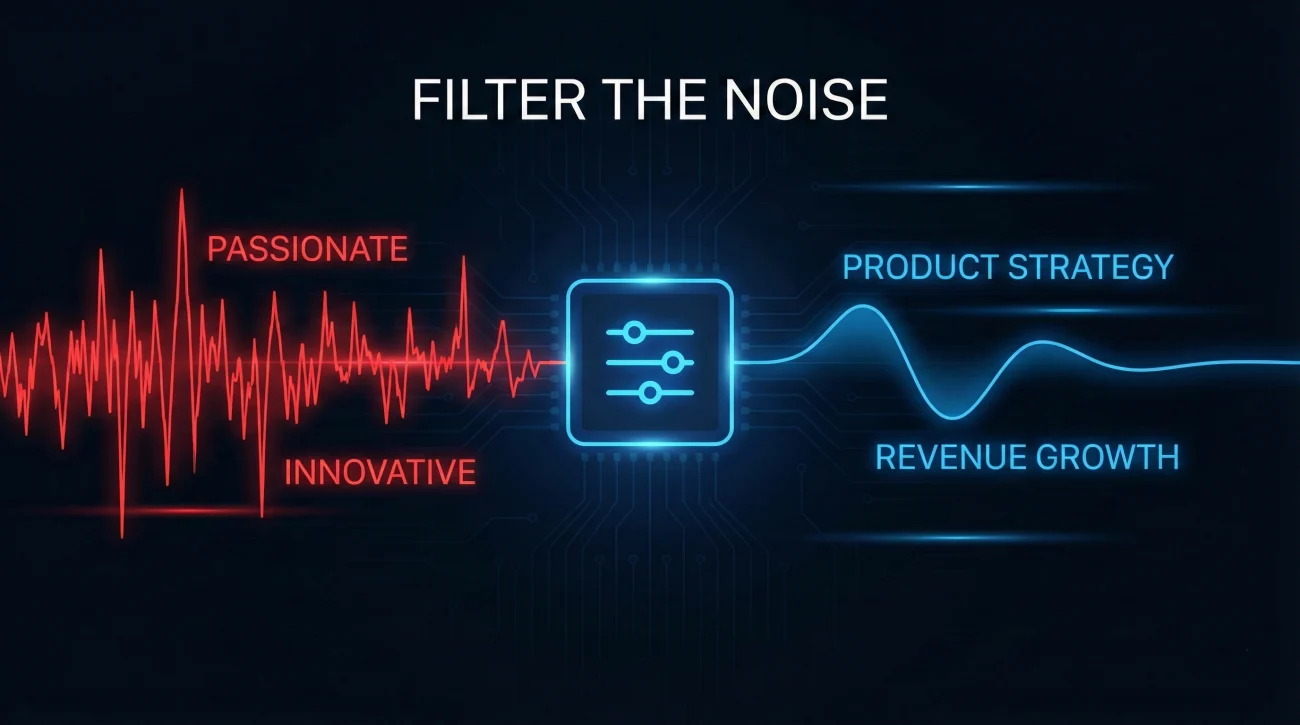
The most pervasive error on the platform is the reliance on “Empty Signifiers” – words that sound impressive but carry zero informational weight.
The Mechanics of the Error
Professionals often fill their 220 characters with adjectives like “Passionate,” “Innovative,” “Strategic,” “Dynamic,” or “Results-Driven.” While these qualities are desirable, they are subjective self-assessments, not objective data points.
Why It Fails (The SEO Perspective):
Recruiters do not type adjectives into the search bar. A recruiter looking for a CFO does not search for “Passionate Finance Leader.” They search for “CFO,” “CPA,” “Mergers & Acquisitions,” and “GAAP.” When you occupy your prime real estate with buzzwords, you displace the high-value keywords that actually drive search traffic.
Why It Fails (The Psychological Perspective):
Psychologically, self-proclaimed traits trigger skepticism. If you have to tell me you are “Innovative,” you probably aren’t. True innovation is demonstrated through patents, products launched, or revenue generated. Buzzwords are the hallmark of a junior professional trying to inflate a thin resume.
| ❌ The Buzzword (Noise) | ✅ The Objective Skill (Signal) |
|---|---|
| “Innovative Problem Solver” | “Product Strategy & Roadmap Execution” |
| “Passionate Communicator” | “Public Relations & Crisis Management” |
| “Results-Oriented Leader” | “Scaled Revenue from $5M to $20M” |
| “Synergy Expert” | “Cross-Functional Team Leadership” |
Mistake #2: The “Creative” Title (Semantic Mapping Failure)

In an attempt to stand out, many professionals adopt whimsical titles like “Chief Happiness Officer,” “Code Ninja,” “Marketing Guru,” or “Data Wizard.” While this may signal a fun personality, it is a catastrophic SEO strategy.
The Algorithm Hate “Ninjas”
LinkedIn’s search algorithm (and the Applicant Tracking Systems used by large companies) relies on Semantic Mapping. It maps search queries to standardized job taxonomies. The system knows that “Software Developer” and “Application Engineer” are related. It does not know that “Code Wizard” is a synonym for “Senior Backend Engineer.”
The Recruiter’s Boolean Logic:
Recruiters use Boolean search strings (e.g., "Product Manager" AND "SaaS" AND "Agile"). If your title is “Product Visionary,” you fail the exact match requirement. You are voluntarily removing yourself from 99% of professional searches.
The Dual-Title Strategy
If your official internal title is creative (e.g., “Customer Hero”), you must translate it for the external market.
The Fix: Use the standard industry title in your headline for SEO, and mention the creative internal title in your Experience section description.
Headline: “Customer Success Manager | SaaS Onboarding”
Experience Section: “Title: Customer Hero (Internal title for CSM role)…”
Mistake #3: The Default Settings (The “Passive” Signal)
If you do not edit your headline, LinkedIn defaults to: [Current Job Title] at [Current Company].
Why Default is Deadly
1. The “Lazy” Signal:
Keeping the default headline signals to recruiters that you are not active on the platform, or worse, that you lack digital literacy. In competitive fields like Tech or Marketing, an unoptimized profile is a red flag.
2. Context Blindness:
“Account Manager at X-Corp” tells me nothing if I don’t know what X-Corp does. Are you in Tech? Pharma? Logistics? Without context (Industry/Niche), the recruiter cannot assess your relevance. They will not click to find out; they will scroll to the next candidate who explicitly states “SaaS Account Manager.”
3. Zero Value Proposition:
Your job title is what you are, not how you add value. You have wasted 180+ characters of space that could have been used to highlight hard skills, achievements, or specialized domain knowledge.
Mistake #4: The Missing Hard Skills (The Keyword Void)
A headline that describes your philosophy (“Helping companies grow”) but omits your toolkit is a strategic failure. Recruiters filter by Hard Skills.
The Anatomy of a Filtered Search
When a recruiter opens LinkedIn Recruiter, they rarely search just for a title. They search for a Title + Skill Stack.
Query: “Data Analyst” + “SQL” + “Tableau” + “Python”.
If your headline is just “Data Analyst at Bank of America,” you are ranked lower than “Data Analyst | SQL, Python, Tableau Expert.” The algorithm prioritizes profiles where the keywords appear in the Headline first, then the About section, then Experience.
👉 The Fix: Conduct a keyword audit. Look at 10 job descriptions for your target role. What are the 3-5 technical skills that appear in every “Requirements” section? Those skills belong in your headline.
Mistake #5: Skill Stuffing (Cognitive Overload)

The opposite of the missing skills mistake is the “Laundry List.” This is where a candidate lists every single tool they have ever touched.
Example: “Developer | Java, C++, Python, R, HTML, CSS, React, Angular, Vue, SQL, NoSQL, AWS, Azure, GCP, Docker, Kubernetes, Jenkins, Git…”
The Paradox of Choice
1. Dilution of Expertise:
When you list 20 skills, you signal that you are a generalist in everything and a master of nothing. A Senior Developer is usually a specialist (e.g., “Full Stack with React/Node focus”).
2. Cognitive Strain:
As discussed in our psychology guide, humans cannot process unstructured lists. It looks messy and desperate. It suggests you don’t know what your primary value proposition is.
The Strategic Fix: Curate. List your “Top 3-4” distinct skills that command the highest market rate. Move the secondary skills to the “Skills” section of your profile.
Mistake #6: Desperation Signals (The Leverage Killer)
Phrases like “Actively Seeking Opportunities,” “Open to Work,” or “Looking for new challenges” in the headline text are controversial, but strategically, they are often a mistake for senior professionals.
Social Value Theory
In high-end hiring, desirability is correlated with scarcity. The most coveted candidates are “Passive Candidates” – those who are so good they are currently employed and need to be courted.
When you write “Unemployed and Looking,” you anchor your value at zero. You lose negotiation leverage before the first interview. It signals: “I need you more than you need me.”
The Better Alternative:
Use LinkedIn’s “Open to Work” feature (the green frame), which allows you to signal availability to recruiters only without broadcasting it to your entire network or cluttering your headline. Keep your headline focused on value (“Marketing Director | Driving B2B Growth”), not status.
Mistake #7: Mismatched Seniority (Imposter vs. Dunning-Kruger)
This mistake manifests in two directions: Junior people over-claiming, and Senior people under-claiming.
The Two Extremes
1. The Junior Inflator (Dunning-Kruger):
A recent graduate calling themselves a “Visionary Leader” or “Strategic Consultant.” This creates immediate cognitive dissonance. The recruiter looks at the “Experience” section, sees 1 year of work, and feels deceived. Trust is broken instantly.
2. The Senior Underseller (Imposter Syndrome):
A VP with 20 years of experience who writes “Manager” or lists tactical skills like “Microsoft Word.” If you are an executive, your headline must signal Scope (Budget, Team Size, Strategy), not tools. Listing “Excel” as a skill for a CFO role devalues your strategic brand.
The 5-Minute Headline Audit
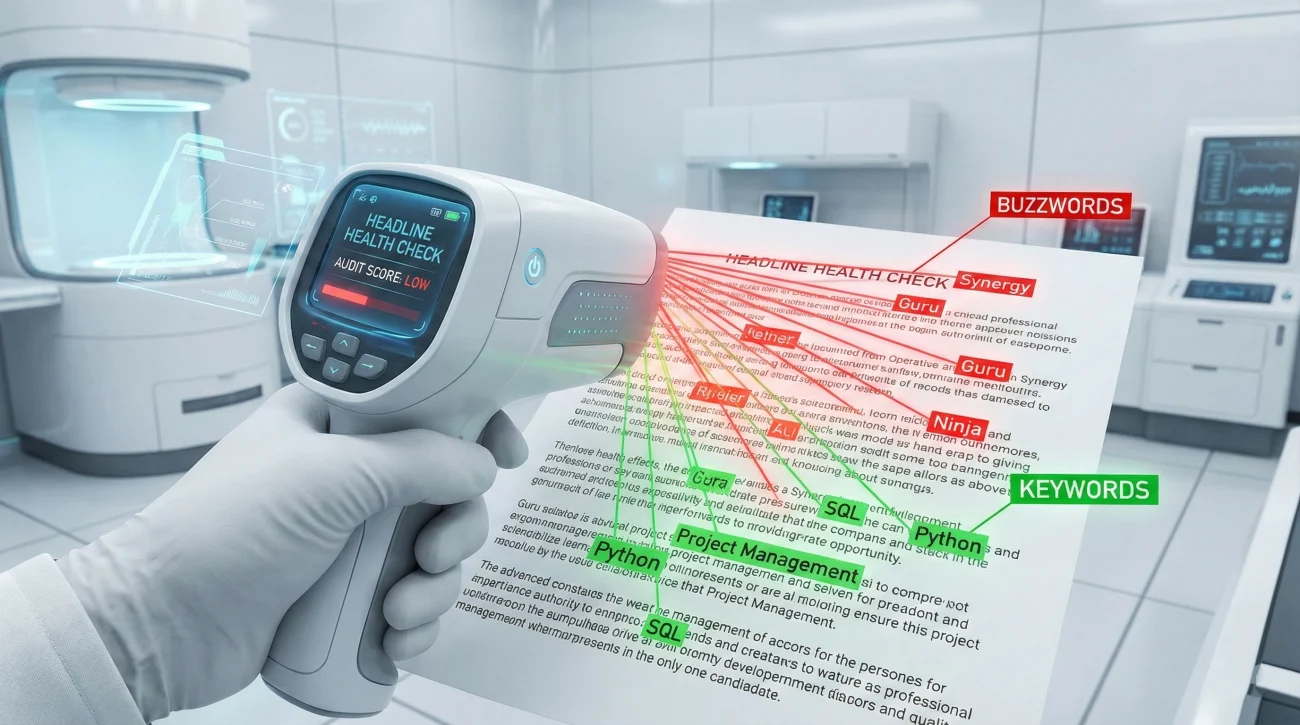
How do you know if your headline is guilty? Perform this rapid audit right now.
- 1️⃣ Step 1: The Buzzword Count. Read your headline. Underline every adjective (Passionate, Strategic, etc.). If you have more than 1, delete them.
- 2️⃣ Step 2: The “Grandma Test” (Clarity). Show your headline to someone outside your industry. If they cannot tell you 3️⃣ exactly what you do and who you do it for, your title is too creative or vague.
- Step 3: The Keyword Match. Search for your target job title on LinkedIn. Look at the “People” tab. Do the top 5 results have keywords in their headline that you are missing?
- 4️⃣ Step 4: The Mobile Check. View your profile on the LinkedIn mobile app. The first 40-60 characters are the most critical. Is your biggest selling point visible without clicking?
❓ FAQ: Fixing Headline Mistakes
🔧 I have a creative title at work. Will I get in trouble for changing it on LinkedIn?
📉 My views dropped after I changed my headline. Why?
🚫 Should I use emojis to stand out?
🔄 How do I list multiple roles (e.g., Job + Side Hustle)?
Final Thoughts: Precision Over Personality
The overarching lesson of these 7 common headline mistakes in 2025 is that clarity must always precede cleverness. Your personality is a vital asset, but your headline is not the place to showcase it at the expense of findability.
Think of your headline as the address on an envelope. If you write a beautiful poem on the envelope but forget the zip code, the letter will never be delivered. Your headline’s job is to get the letter (your profile) delivered to the right person (the recruiter). Once they open it (click your profile), then you can use your About section and Content to show your personality, passion, and creativity.
Fix these mistakes today. The impact is often immediate. You will move from being invisible to being indexed, and that is the first step toward landing your next major opportunity.
To see examples of error-free, high-performance headlines, verify your strategy against our industry-specific examples. For a complete rebuild of your profile strategy, read our core LinkedIn Headline Guide.
Before you rewrite your profile, spend five more minutes on the blog – you’ll walk away with better ideas and stronger headlines.