
- Visibility gap: Competence does not equal visibility because LinkedIn works like a searchable database, not a social feed.
- Recruiter funnel: You must survive Boolean filters, rank high in relevancy sorting, and win the headline plus photo visual scan.
- Headline SEO: Start with a standard anchor title recruiters search, then add hard skills and context instead of keyword dumping.
- Metadata stack: Standardize job titles, pin hard skills, and write experience bullets as Tool plus Action plus Result to prove keywords.
- Maintenance and testing: Use location and Open To settings smartly, complete your profile for All-Star strength, and run a Boolean self-audit to see if you rank.
The Invisible Candidate Paradox
There is a harsh reality in the modern job market that very few career coaches discuss: Competence does not equal visibility. You can be the most qualified Software Engineer, the most strategic Marketing Director, or the most efficient Project Manager in your industry, and yet remain completely invisible to the people trying to hire you.
Why? Because LinkedIn is not a social network in the traditional sense; it is a massive, structured database. And like any database, it is governed by a strict retrieval algorithm. Recruiters using the premium LinkedIn Recruiter platform do not browse profiles hoping to stumble upon talent. They execute surgical, complex queries designed to filter out 99% of the population.
If your profile does not align perfectly with the taxonomy of these queries – if you use “Creative Coder” instead of “Software Engineer,” or “Guru” instead of “Specialist” – you are functionally non-existent. You are not being rejected; you are simply not being indexed.
This guide is a deep dive into the mechanics of LinkedIn profile optimization. We will reverse-engineer the recruiter’s workflow, dissect the search algorithm, and provide you with a granular blueprint to ensure that when the perfect role opens up, your name is the first one on the list.
Inside the Black Box: How Recruiters Actually Search
To optimize your profile, you must stop thinking like a candidate and start thinking like a database architect. Recruiters are risk-averse pattern matchers working under intense time pressure.
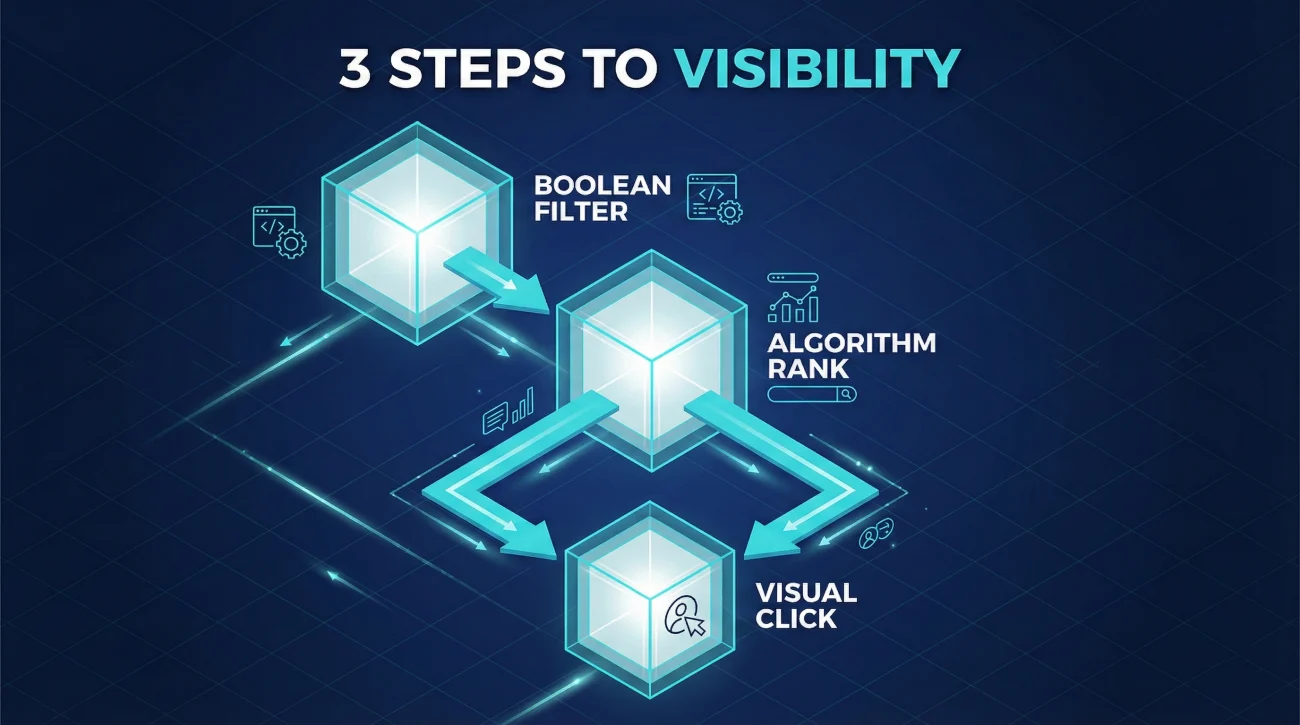
The 3-Step Search Funnel
Understanding this workflow is the key to unlocking visibility.
- 1. The Boolean Command (The Filter): A recruiter starts with a string like: (“Product Manager” OR “Product Owner”) AND (“SaaS” OR “B2B”) AND “Agile” AND “San Francisco” NOT “Intern”. If your profile lacks these exact keywords, you are filtered out instantly.
- 2. The Relevancy Sort (The Ranking): LinkedIn returns 2,000 results. No recruiter looks at page 50. They look at page 1. The algorithm ranks these 2,000 profiles based on “Keyword Density,” “Network Proximity,” and “Profile Completeness.”
- 3. The Visual Scan (The Click): Finally, the human eye scans the top 20 results. They look at the Headline and Headshot. If these don’t scream “Professional,” they scroll past.
👉 Strategic Insight: Optimization is a game of survival. You must survive the Boolean Filter, win the Relevancy Sort, and convert the Visual Scan.
1. The Headline: Your Primary SEO Asset

Your Headline is not just a slogan; it is the highest-weighted SEO field on your entire profile. The algorithm assumes that words in your Headline define your current core identity.
Tactical Optimization
The “Keyword Stuffing” Fallacy: While keywords are essential, stuffing them (“Marketing | Sales | Growth | SEO | SEM | PPC”) looks desperate to humans. You need a hybrid approach.
The “Anchor Title” Strategy: Always start with the standard job title recruiters search for. Even if your internal title is “Customer Happiness Hero,” your headline must say “Customer Success Manager.”
❌ Invisible: “Helping companies grow through innovative tech solutions”
✅ Visible: “Senior Solutions Architect | Cloud Infrastructure (AWS/Azure) | DevOps & CI/CD”
For a complete breakdown of headline mechanics, refer to our master guide on crafting the perfect LinkedIn headline.
2. Job Titles: The Standardization Imperative
One of the most common mistakes high-performers make is using “Vanity Titles” or specific internal company jargon. This is fatal for SEO.
The Taxonomy Problem
LinkedIn’s algorithm attempts to categorize every user into a standardized taxonomy. If you use a title it doesn’t recognize, it cannot categorize you.
| Internal/Creative Title (Avoid) | Standardized Search Title (Use) |
|---|---|
| Innovation Sherpa | Product Manager |
| Brand Storyteller | Content Marketing Manager |
| Full Stack Ninja | Senior Software Engineer |
| Accounts Lead | Account Executive / Account Manager |
The Fix: If you want to keep your vanity title, list it in the description, not the title field.
Title Field: Marketing Director
Description: “Internal Title: Head of Global Brand Magic…”
3. The Skills Section: The Semantic Engine

Many users ignore the “Skills & Endorsements” section, thinking it’s outdated. Wrong. It is a critical metadata layer for the algorithm.
The “Hard Skills” Priority
Recruiters rarely filter by “Leadership” or “Communication” because those are assumed soft skills. They filter by hard, verifiable skills. Your top 3 pinned skills should always be hard skills relevant to your target role.
- For Tech: Python, React, Kubernetes (Not “Problem Solving”).
- For Sales: Salesforce, B2B Sales, Cold Calling (Not “People Skills”).
- For Finance: Financial Modeling, GAAP, Excel Macros (Not “Hard Worker”).
💡 Pro Tip: Go to the “Jobs” tab on LinkedIn. Look at 5 descriptions for your target role. LinkedIn often lists the “Top Skills” required for that job. Ensure every single one of those matches is in your profile.
4. The Experience Section: Contextual Keywords
Listing keywords is step one. Step two is providing context. The algorithm (and the human) needs to see that you didn’t just dump keywords, but that you actually used these skills to achieve results.
The “Tool + Action + Result” Framework
Do not just write “Used Python.” Write:
"Built a predictive analytics engine using Python and TensorFlow, reducing customer churn by 15%."
This does three things:
- It hits the keywords (Python, TensorFlow).
- It proves competency (Built an engine).
- It proves value (Reduced churn).
5. Location & “Open To” Settings: The Radius Filter
If you are looking for a job in New York, but your profile says “New Jersey,” you might be filtered out by a recruiter who sets a strict “25-mile radius” filter to avoid paying relocation costs.
The Remote Worker’s Dilemma
If you want remote work, do not just set your location to “Remote” (which can sometimes be buggy in search).
Strategy: Set your location to the major metro hub of your industry (e.g., San Francisco for Tech, NYC for Finance) to appear in searches, but clearly state “Remote Only” in your Headline and “Open To Work” settings. This gets you into the search funnel, giving you a chance to negotiate the location later.
The “All-Star” Boost: Why Completeness Matters
LinkedIn explicitly penalizes incomplete profiles. They have a metric called “Profile Strength.” If you are not an “All-Star,” your reach is throttled.
The Checklist for Maximum Reach:
- ✓ Photo: Profiles with photos get 21x more views. No photo = “Bot” or “Inactive.”
- ✓ Industry: This is a major filter. Ensure you are categorized correctly (e.g., “Software Development” vs “Information Technology”).
- ✓ Education: Even if you are 20 years into your career, list your university. Alumni searches are a massive sourcing channel for recruiters.
- ✓ 50 Skills: Max out the skills section. It costs you nothing and increases your keyword surface area.
Searchability Killers: Common Mistakes
| The Mistake | The Consequence | The Fix |
|---|---|---|
| The “Generalist” Trap | Listing too many disparate roles (“Writer / Designer / Coder”) confuses the algorithm. | Pick a lane. Optimize for one primary role. Put secondary skills in the “About” section. |
| The “Creative” Headline | Using emojis or vague phrases (“Making magic happen ✨”) wastes prime SEO real estate. | Use standard titles + hard skills. Save personality for the Summary. |
| Dormant Profile | Profiles with zero activity (likes/comments) are ranked lower by the “Freshness” algorithm. | Engage (like/comment) 2-3 times a week to signal you are an active user. |
| Acronym Blindness | Using “PM” instead of “Product Manager.” | Spell it out first: “Product Manager (PM).” Capture both search variations. |
The “Boolean Audit”: How to Test Your Profile
Don’t just guess if you are searchable – prove it. You can audit your own profile by simulating a recruiter’s search.

Step-by-Step Self-Audit
- Open LinkedIn (or Incognito Mode).
- Type a Boolean string that a recruiter would use to find you.
Example: “Project Manager” AND “SaaS” AND “PMP” - Filter by “People” and your “Location.”
- See where you rank. Are you on Page 1? Page 10? Not there at all?
If you aren’t on Page 1 or 2, your keyword density is too low, or your network is too small (2nd and 3rd-degree connections rank lower). Start optimizing immediately.
Maintenance: The “Freshness” Signal
LinkedIn’s algorithm loves “Freshness.” A profile updated yesterday ranks higher than one updated 2 years ago, all else being equal.
The “Pulse Check” Routine (Quarterly):
- • Rotate Skills: Move new top skills to the top 3 slots.
- • Refresh Headlines: Tweak a keyword or two.
- • Update Projects: Add a recent win to your current role description.
These micro-actions force the algorithm to re-index your profile, giving you a temporary visibility boost.
For more examples of optimized profiles, browse our library of industry-specific headline examples.
❓ FAQ: Advanced Optimization
🌐 Should I create a profile in another language?
🔒 Can my current employer see if I optimize my profile?
🔢 How many connections do I need to rank well?
📝 Does the “About” section count for SEO?
Final Thoughts: Visibility is a Choice
Being “found” on LinkedIn is not an accident. It is an engineering problem. It is the result of aligning your digital signal with the receiver’s frequency.
Most professionals leave their career to chance. They hope their good work speaks for itself. But on a database of 900 million users, “hope” is not a strategy. Optimization is.
By standardizing your titles, front-loading your keywords, and understanding the recruiter’s boolean logic, you move from being a passive participant in the job market to an active magnet for opportunities. Stop hiding in the database. Light up the dashboard.