

- Mindset shift: Stop treating your headline like a label, use it as positioning that follows you in search, comments, and recommendations.
- 10 formulas: Pick from Search-First, Authority Anchor, Solution Seller, Expert Stack, Executive Scope, plus 5 advanced frameworks for pivots, hybrids, geography, growth stage, and pure results.
- Choose by goal: Match the formula to what you need most, like discoverability, credibility, lead gen, proof, or leadership scope, then tailor for your audience.
- Psychology: Win clicks with Familiarity plus Awe, Specificity for trust, and costly signals like metrics, credentials, and prestige brands.
- Avoid mistakes: Skip “Open to work” as your identity, keyword soup, internal titles, and fluffy claims, keep clarity for mobile, and update only when triggers are real.
The Strategic Architecture of a High-Performing Headline
Most professionals treat their LinkedIn headline as a static label – a digital name tag that simply states their current job title. This is a fundamental strategic error. In the economy of attention, your headline is your most valuable asset. It is the only piece of content, aside from your profile picture, that follows you everywhere on the platform: into recruiter search results, onto the comments you leave, and into the “People You May Know” sidebar.
When you rely on default settings (e.g., “Marketing Manager at Company X”), you are invisible to the algorithms that drive discovery and uncompelling to the humans who make hiring decisions. To compete effectively, you must shift your mindset from “describing” to “positioning.”
This guide moves beyond surface-level templates. We are going to deconstruct 10 LinkedIn headline formulas that have been stress-tested across thousands of profiles. We will analyze the cognitive psychology behind why they work, the specific signaling mechanisms they employ, and exactly how to deploy them to align with your career trajectory.
1. The Search-First Standard: Role + Industry + Hard Skills
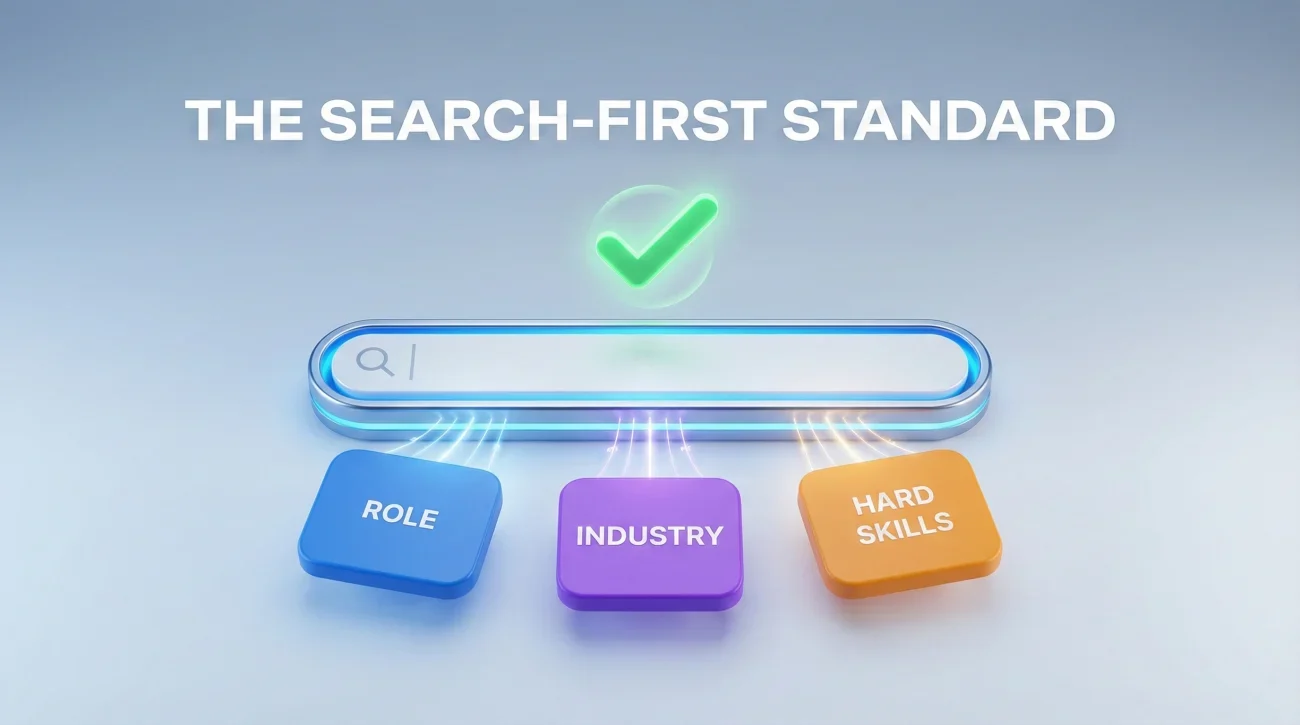
This is the foundational structure for the modern digital job market. Understanding why role industry skills works requires looking at LinkedIn not as a social network, but as a search engine database.
The Architecture
[Target Job Title] | [Industry/Niche] | [Hard Skill 1], [Hard Skill 2], [Hard Skill 3]
Strategic Examples:
- ℹ️ “Senior Software Engineer | FinTech & Payments | Python, AWS, Kubernetes”
- ℹ️ “Digital Marketing Manager | B2B SaaS | SEO, SEM, HubSpot Certified”
- ℹ️ “Supply Chain Analyst | Global Logistics | SAP, SQL, Inventory Management”
Why It Works: The Algorithm & The Human
The Algorithmic Hook:
Recruiters use LinkedIn Recruiter (a paid tool) to find talent. They filter primarily by Title, Location, and Skills. This formula hits the “Title” and “Skills” filters with exact-match precision. By explicitly listing “Python” or “SEO,” you are directly feeding the search algorithm the data it craves.
The Cognitive Fluency:
For the human reader, this format offers high “processing fluency.” It requires zero mental effort to understand who you are (Role), where you operate (Industry), and what tools you use (Skills). In a sea of ambiguous titles like “Wizard of Code,” this clarity signals professionalism and confidence.
Strategic Application
Use this formula if you are an individual contributor (IC) or mid-level manager looking to change jobs. It is the safest, most effective bet for maximizing visibility in recruiter searches.
2. The Authority Anchor: Title + Prestige Company + Impact

If you have worked for a market leader, your strategy shifts from “discoverability” to “credibility.” This formula leverages the brand equity of your employer to elevate your personal brand.
The Architecture
[Role] at [Prestige Company] | [Major Achievement/Scope]
Strategic Examples:
- ℹ️ “Product Manager at Google | Building Maps for 1B+ Daily Users”
- ℹ️ “Sales Director at Salesforce | Driving $50M+ ARR in Enterprise Cloud”
- ℹ️ “Management Consultant at McKinsey | Digital Transformation Strategy”
Why It Works: The Halo Effect
The Halo Effect:
Psychologically, humans struggle to evaluate competence in isolation. We use shortcuts. When a reader sees a prestigious company name (e.g., Google, Apple, Goldman Sachs), they subconsciously transfer the qualities of that company (excellence, intelligence, rigor) to you. You essentially “borrow” the trust the company has already built.
Social Proof:
It signals that you have passed a rigorous selection process. You are “pre-vetted.” This reduces the perceived risk for a recruiter or hiring manager.
Strategic Application
Deploy this only if the company brand is stronger than your personal brand, or if the company is universally recognized in your target industry. If you work for a small, unknown firm, this formula loses its leverage.
3. The Solution Seller: Problem + Audience + Method

This is the go-to formula for consultants, freelancers, and sales professionals. It moves away from “who I am” to “what I can do for you.”
The Architecture
Helping [Target Audience] [Solve Specific Problem] via [Method/Mechanism]
Strategic Examples:
- ℹ️ “Helping Pre-Seed Startups Secure Funding | Pitch Deck Design & Financial Modeling”
- ℹ️ “Helping E-commerce Brands Scale to 8-Figures | Paid Social & Retention Strategy”
- ℹ️ “Solving Complex Tax Issues for Expatriates | International Tax Law Specialist”
Why It Works: The “WIIFM” Factor
“What’s In It For Me?” (WIIFM):
Clients do not care about your job title; they care about their own pain points. This formula speaks directly to the lizard brain’s desire for survival and gain. By naming the specific problem, you trigger an immediate “that’s me” reaction in your ideal client.
Differentiation:
It positions you not as a commodity (e.g., “Graphic Designer”) but as a specialist (e.g., “Pitch Deck Specialist”). Specialists can charge premiums; generalists compete on price.
Strategic Application
Essential for anyone responsible for revenue generation or client acquisition. Avoid this if you are a corporate job seeker, as Applicant Tracking Systems (ATS) and internal recruiters often search for standard job titles, not solution statements.
4. The Expert Stack: Niche + Outcomes + Credentials

For highly technical fields or regulated industries (Finance, Law, Medicine, Engineering), trust is the currency. This formula stacks authority markers to build an unassailable fortress of credibility.
The Architecture
[Niche Specialty] | [Quantified Result] | [Top-Tier Credential]
Strategic Examples:
- ℹ️ “M&A Attorney | $10B+ in Closed Transactions | NY Bar”
- ℹ️ “Cybersecurity Architect | Secured 50k+ Endpoints | CISSP, CISM”
- ℹ️ “Biotech Researcher | 12 Patents Filed | PhD in Molecular Biology”
Why It Works: The Authority Bias
Authority Bias:
We are conditioned to trust credentials and specific numbers. “Cybersecurity” is vague; “CISSP” is a verifiable standard. “$10B in transactions” is an objective fact. This formula leaves no room for doubt regarding your competence.
Risk Mitigation:
In high-stakes roles, hiring managers are terrified of making a mistake. Credentials and track records act as an insurance policy for their decision-making process.
Strategic Application
Use this when your field values formal education and certification (e.g., CPA, CFA, PhD, MD, PE). It is less effective in creative fields where portfolios matter more than acronyms.
5. The Executive Scope: Leadership Level + Team Size + Domain

As you ascend to Director, VP, and C-Suite levels, your technical skills matter less than your ability to manage scale, resources, and people. This formula pivots to showcase organizational impact.
The Architecture
[Executive Title] | Leading [Team Size/Function] | [Strategic Domain]
Strategic Examples:
- ℹ️ “VP of Engineering | Leading a Global Team of 150+ Developers | Cloud Infrastructure”
- ℹ️ “Chief Revenue Officer | Managing $100M+ P&L | Enterprise SaaS Scaling”
- ℹ️ “Director of Operations | Overseeing 5 Manufacturing Sites | Lean Six Sigma”
Why It Works: Signaling Capacity
Scale as a Proxy for Competence:
Leading 5 people is different from leading 150. Managing a $50k budget is different from a $50M P&L. By stating the numbers, you anchor your seniority instantly. It prevents recruiters for smaller roles from wasting your time and signals to executive search firms that you can handle the weight of the position.
Strategic Application
Mandatory for senior leadership. Do not list hard skills like “Excel” or “Python” here – it makes you look tactical rather than strategic. Focus on the scope of your influence.
Advanced & Unique Headline Frameworks
Sometimes, the standard formulas do not fit unique career paths or specific market conditions. Here are five unique headline frameworks designed for nuance and specific strategic maneuvers.
6️⃣ Formula 6: The Pivot Bridge: Former Role → Future Value
6. The Pivot Bridge: Former Role → Future Value
Structure:
[Current/Former Role] Transitioning to [New Field] | [Transferable Skill 1], [Transferable Skill 2]
💡 Why It Works: It owns the narrative. Instead of looking like a confused generalist, you frame your background as a unique asset. For example, a “Teacher turned Customer Success Manager” brings patience and instructional design skills that a standard CSM might lack.
💯 Best For: Career changers who need to connect the dots for recruiters.
7️⃣ Formula 7: The Hybrid Specialist: Skill A + Skill B = Unique Value
7. The Hybrid Specialist: Skill A + Skill B = Unique Value
Structure:
[Skill A] + [Skill B] | [Unique Intersection]
💡 Why It Works: It exploits the “Talent Stack” concept (popularized by Scott Adams). You might not be the best writer, or the best finance expert, but if you are a “Financial Copywriter,” you are in the top 1% of that niche.
💯 Best For: Polymaths and roles that sit at the intersection of departments (e.g., DevOps, Product Marketing, Legal Tech).
8️⃣ Formula 8: The Geography Play: Role + Region + Local Expertise
8. The Geography Play: Role + Region + Local Expertise
Structure:
[Role] | [Specific Region] | [Local Market Nuance]
💡 Why It Works: In real estate, law, and regional sales, local knowledge is the primary value driver. It signals that you have the network and the cultural context ready to go on Day 1.
💯 Best For: Realtors, Regional Sales Managers, Local Business Consultants.
9️⃣ Formula 9: The Growth Stage Specialist: Role + Company Stage
9. The Growth Stage Specialist: Role + Company Stage
Structure:
[Role] | [Company Stage: Pre-Seed / Series A / IPO] | [Stage-Specific Skill]
💡 Why It Works: A CFO for a stable corporation has a totally different job description than a CFO for a Series A startup. Specifying the stage signals that you understand the chaos (or structure) required.
💯 Best For: Startup veterans and turnaround specialists.
🔟 Formula 10: The Pure Results: Metric | Metric | Metric
10. The Pure Results: Metric | Metric | Metric
Structure:
[Major Achievement 1] | [Major Achievement 2] | [Core Competency]
💡 Why It Works: It is bold. It assumes your reputation precedes you. It bypasses the “what I do” to focus entirely on “what I have done.” It is a power move.
💯 Best For: High-performing sales leaders and entrepreneurs with undeniable track records.
Strategic Comparison: Which Formula Fits You?

Choosing the right formula is not about aesthetics; it is about alignment with your current career objective. Use this comparison matrix to identify your best fit.
| Formula Type | Primary Goal | Best Audience | Key Risk |
|---|---|---|---|
| 1. Search-First | Discoverability (SEO) | Recruiters & ATS | Can feel generic if not customized |
| 2. Authority Anchor | Credibility / Trust | Hiring Managers | Ineffective if company is unknown |
| 3. Solution Seller | Lead Generation | Potential Clients | May alienate corporate recruiters |
| 4. Expert Stack | Proof of Competence | Technical Peers | Can feel cold or overly academic |
| 5. Executive Scope | Leadership Positioning | Board Members / C-Suite | Can seem detached from execution |
The Psychology of Clickable Headlines
To truly master the art of the headline, you must understand the psychology of clickable headlines. Why does one profile get clicked while another is ignored? It comes down to how the human brain filters information.
1. Pattern Recognition and Disruption
Recruiters scan hundreds of profiles an hour. Their brains are looking for patterns (keywords). If you deviate too far (e.g., “Chief Happiness Officer” instead of “HR Director”), you break the pattern, but often in a negative way that causes confusion. However, if you follow the pattern and add a “disruptor” (like a massive number or a prestige brand), you capture attention. The goal is: Familiarity + Awe.
2. The Specificity Heuristic
Vague claims (“Experienced Leader”) trigger skepticism. Specific claims (“Managed Team of 50”) trigger trust. In behavioral economics, this is known as the Specificity Heuristic. We subconsciously assume that if someone can provide a specific detail, it must be true. Specificity is a proxy for honesty.
3. Borrowed Social Capital
When you include a credential (CPA) or a company (Amazon), you are leveraging “signaling theory.” You are displaying a badge that is costly to obtain. This separates you from the “cheap talk” of others who simply claim to be “hardworking.” In a low-trust digital environment, costly signals are the only ones that matter.
For more insights into crafting headlines that leverage these psychological triggers, review our foundational LinkedIn Headline Guide.
Common Headline Mistakes to Avoid
Even with the right formula, execution matters. Avoid these common pitfalls that can dilute your positioning.
| ❌ The Mistake | ✅ The Strategic Fix |
|---|---|
| The “Unemployed” Signal Writing “Seeking New Opportunities” or “Open to Work” as the entire headline. | Keep Your Value First Use Formula 1, and add specific skills. Your value is your skill set, not your availability. |
| The Keyword Stuffing “Marketing | Sales | Growth | SEO | Content | Ninja | Guru” | The Focused Specialist Pick a lane. “Growth Marketing Manager | B2B SaaS | SEO & Content Strategy”. Cohesion beats chaos. |
| The Internal Jargon Using titles like “Level 4 Programmer” or “Grade 2 Analyst” that only your company understands. | The Market Standard Translate your title to the industry equivalent. “Senior Software Engineer” or “Financial Analyst”. |
| The Abstract Fluff “Helping companies reach the stars” or “Passionate change-maker”. | The Concrete Result “Helping Series B Startups Scale Revenue” or “Change Management Consultant”. Be specific. |
❓ FAQ: Mastering Your Headline Strategy
💰 Which headline formula is best for a salary negotiation?
📱 How often should I update my LinkedIn headline?
⏰ Can I use emojis in my LinkedIn headline?
🔍 Will changing my headline affect my search ranking?
Final Thoughts: Your Headline is Your Business Card
Your LinkedIn headline is a strategic tool, not a biography. It requires a deliberate choice: Are you optimizing for search? Are you building authority? Are you selling a solution?
By applying one of these 10 LinkedIn headline formulas, you move from being a passive participant in the job market to an active architect of your career narrative. Remember, clarity beats creativity. Specificity beats generalization. And a strategic headline beats a default one every single time.
Start by auditing your current headline against the decision framework above. If it doesn’t clearly state your value, your scope, or your expertise, it is time for a rewrite.
If you’re serious about your job search, make sure you read a few more articles from the blog before you log off.