- Core idea: Your Headline earns the click, but your About section closes the deal by proving you can solve a specific problem.
- Reader psychology: People scan for Relevance, Authority, and Likability, so you must lead with keywords plus credible proof fast.
- Conversion Architecture: Hook (first 2 lines), Bridge context, Your philosophy, Evidence locker with metrics, Clear CTA.
- Positioning choices: Write in first person for trust, and signal availability without sounding desperate using a neutral bridge line.
- Optimization protocol: Harvest keywords, brain dump wins, run the “So what” test, format for mobile, avoid walls of text and buzzwords.
The Strategic Importance of Your LinkedIn About Section
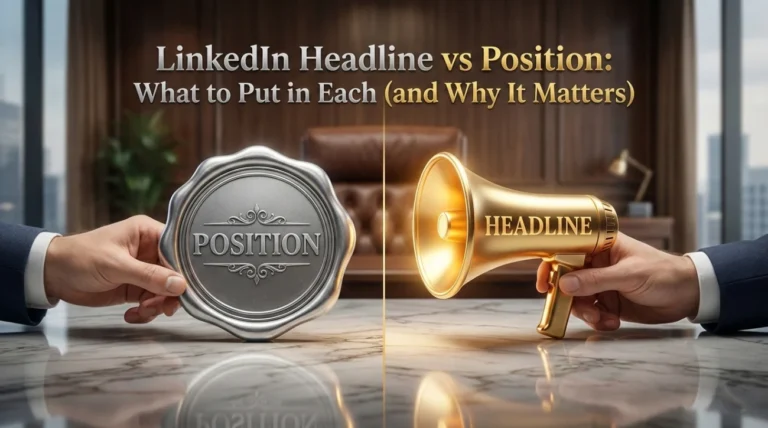
Most professionals treat their LinkedIn About section (formerly known as the Summary) as an afterthought – a place to copy-paste their resume objective or list a few generic adjectives like “hardworking” and “motivated.” This is a fundamental strategic error. In the hierarchy of LinkedIn profile elements, your Headline gets you the click, but your About section closes the deal.
Think of your profile as a landing page. Your Headline is the H1 that drives traffic. Your About section is the sales copy. If you fail to answer the visitor’s subconscious question – “Can this person solve my specific problem?” – within the first three seconds, you have lost an opportunity. Whether you are a job seeker, a sales leader, or a C-suite executive, this section is the only place where you control the narrative, connecting the dots between your past experience and your future value.
In this comprehensive guide, we will dismantle the traditional biography approach and replace it with a conversion-focused framework. We will cover the psychology of recruiter attention, the architectural formulas for different career stages, and how to write a LinkedIn About section that actually generates revenue and opportunities.
The Psychology of the Reader: Why They Scan, Don’t Read
To write effectively, you must first understand the mindset of your audience. Recruiters and potential clients operate in a state of cognitive overload. They do not read profiles for leisure; they scan for risk mitigation and competence signals.
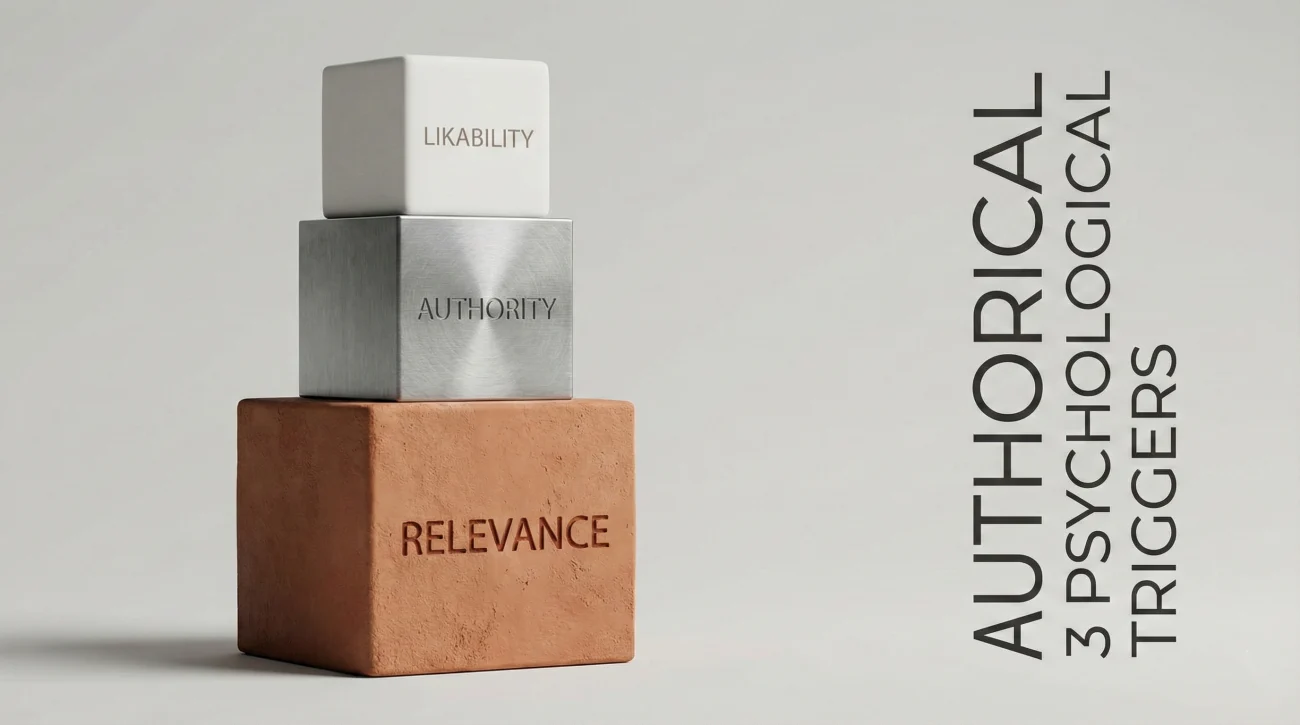
When a human looks at your About section, three psychological triggers fire in sequence:
- 1. The Relevance Filter: “Is this person in the right ballpark?” (Keywords and Industry context).
- 2. The Authority Check: “Do they really know their stuff, or are they fluff?” (Specific metrics vs. generic claims).
- 3. The Likability Factor: “Would I enjoy working with this person?” (Tone, voice, and vulnerability).
Most profiles fail because they focus heavily on the writer’s history (Subjective) rather than the reader’s needs (Objective). A strategic About section flips this dynamic. It acts as an extended elevator pitch that respects the reader’s time while establishing immediate authority.
The 5-Part “Conversion Architecture” Framework
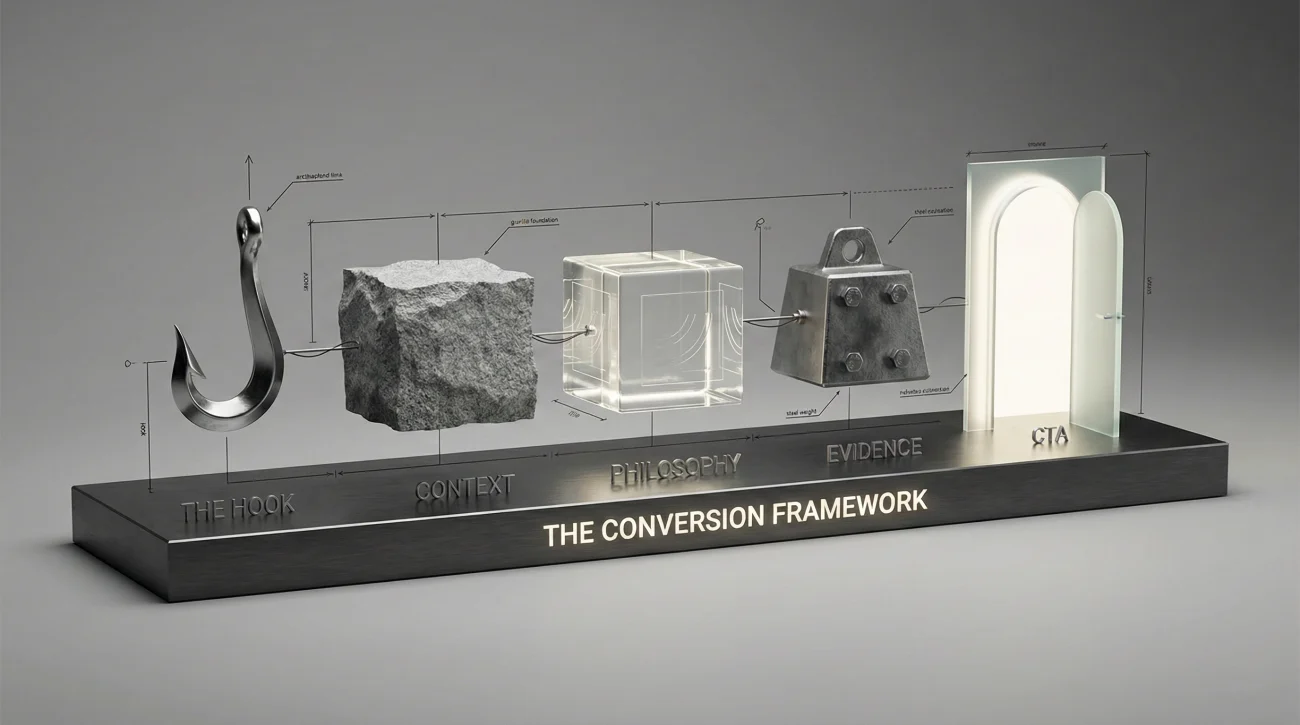
Structure beats creativity when it comes to professional bios. Through analyzing thousands of high-performing profiles, a distinct pattern emerges. The most effective profiles typically follow a five-part narrative arc. This structure works because it logically guides the reader from curiosity to conviction.
1. The “Above the Fold” Hook (The First 2 Lines)
On mobile and desktop, LinkedIn truncates your summary after the first two or three lines. Users must click “See more” to read the rest. If your hook is boring, your story dies there. Avoid starting with “I am a…” followed by your job title – they already saw that in your headline.
Strategy: Start with a value proposition or a provocative statement about your industry.
2. The Professional Context (The “Bridge”)
Once you have their attention, you need to ground them. This is where you summarize your career arc in 3-5 sentences. However, avoid a chronological history lesson. Instead, focus on the evolution of your expertise. How did your past roles prepare you for the complex problems you solve today?
3. Your Unique Philosophy (The “How”)
This is the differentiator. Thousands of people have your job title. None of them think exactly like you. Do you believe in data over intuition? do you believe engineering is about people, not code? This section builds the “Likability Factor” mentioned earlier.
4. The Evidence Locker (Hard Skills & Achievements)
Claims without evidence are merely opinions. This section should include bullet points of hard data. If you are learning how to write LinkedIn about section content that converts, you must speak the language of ROI (Return on Investment).
5. The Call to Action (CTA)
Never leave the reader wondering what to do next. Do you want them to email you? Visit your portfolio? Follow you for content? Be explicit.
Strategic Decision: First Person vs. Third Person
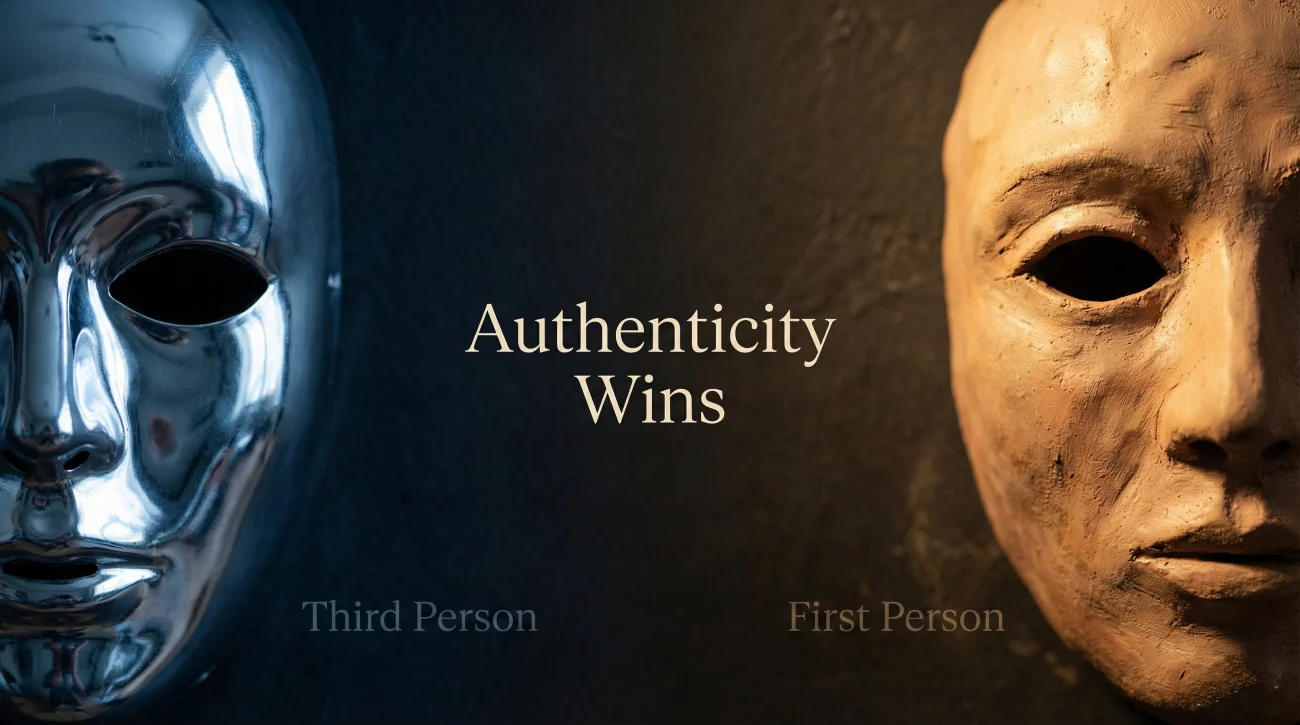
One of the most common questions executives ask is whether to write in the third person (like a bio) or the first person (like a human). While legacy corporate cultures often pushed for the third person, the modern digital landscape favors authenticity.
| Perspective | Pros | Cons |
|---|---|---|
| First Person (“I”) | ✅ Creates an immediate emotional connection. ✅ Feels authentic and conversational. ✅ Highly effective for networking and sales. | ❌ Can sound unprofessional if the tone is too casual. ❌ requires careful balancing to avoid sounding arrogant (“I did this, I did that”). |
| Third Person (“He/She”) | ✅ Sounds formal and prestigious (traditional CEO style). ✅ Useful for speakers who need a bio to be copy-pasted by media. | ❌ Creates psychological distance. ❌ Often perceived as stiff, outdated, or pretentious. ❌ Reduces conversion in direct messaging/networking scenarios. |
The Verdict: Unless you are a Fortune 500 CEO or a public figure where a formal biography is mandatory, always write in the first person. It builds trust faster.
Annotated LinkedIn About Section Examples
Theory is useful, but execution is what matters. Below, we dissect high-performing LinkedIn about section examples across different industries. We have annotated these to show why they work, so you can replicate the logic, not just the words.
1️⃣ Example 1: The Technical Expert (Software Engineer)
Example 1: The Technical Expert (Software Engineer)
Target Audience: CTOs, Engineering Managers, Tech Recruiters.
[The Hook] I build backend systems that handle millions of requests daily without breaking. For the past 8 years, I’ve focused on distributed systems and cloud infrastructure – the unsexy but critical work that keeps applications running smoothly at scale.
[The Context] My engineering career has spanned startups and established tech companies. I’ve worked across fintech and SaaS, which taught me that good system design transcends industries – the principles of reliability and maintainability apply universally.
[The Philosophy] I approach system design by starting with failure scenarios. What happens when the database goes down? How do we handle traffic spikes? This “pessimistic” mindset leads to more resilient systems than optimistic design.
[The Evidence]
• Reduced API latency from 400ms to 60ms through caching optimization.
• Designed microservices architecture scaling from 10K to 2M daily active users.
• Led migration to event-driven architecture, achieving 99.9% uptime.
[The CTA] Currently working on payments infrastructure. Always interested in connecting with engineers solving distributed systems challenges.
Strategist’s Analysis: Notice the lack of buzzwords. Instead of saying “I am a passionate coder,” they say “I start with failure scenarios.” This demonstrates seniority. The evidence section uses specific numbers (400ms to 60ms), which anchors the value in reality.
2️⃣ Example 2: The Revenue Generator (Marketing/Sales Manager)
Example 2: The Revenue Generator (Marketing/Sales Manager)
Target Audience: CEOs, VPs of Sales, Recruiters.
[The Hook] I build marketing engines that generate qualified pipeline for B2B sales teams. Over 10 years, I’ve focused on one thing: creating systematic processes that deliver sales-qualified leads (SQLs) rather than vanity metrics.
[The Context] My career has taken me through venture-backed startups and established software companies. I’ve built marketing functions from zero at Series A startups and scaled mature programs at later-stage companies.
[The Philosophy] I believe B2B marketing requires ruthless focus on revenue metrics. I’d rather have a boring campaign that generates 100 SQLs than a creative viral hit that generates zero revenue. I bridge the gap between “brand” and “sales.”
[The Evidence]
• Grew marketing-sourced pipeline from $8M to $35M annually (2 years).
• Built content strategy generating 80+ SQLs monthly at 35% lower CAC.
• Led rebrand that increased demo request conversion by 45%.
[The CTA] Currently exploring leadership opportunities at Series B-D SaaS companies. If you need to scale your demand gen engine, let’s talk.
Strategist’s Analysis: This profile aggressively filters the audience. By mentioning “Series B-D” and “SQLs,” the writer signals they are not for early-stage chaos or massive corporate stagnation. They speak the language of the CEO (Revenue, CAC, Pipeline), not just the language of marketing (Likes, Traffic).
3️⃣ Example 3: The Solopreneur (Freelance/Consultant)
Example 3: The Solopreneur (Freelance/Consultant)
Target Audience: Founders, Marketing Directors.
[The Hook] I create brand identities for early-stage startups that need to look credible before they have resources for full creative teams.
[The Context & Philosophy] I started freelancing after 3 years at a global agency. I realized startups don’t need months of research; they need “good-enough” branding quickly to go to market. I work fast and iteratively rather than pursuing perfection. My process gets clients to market weeks faster than traditional agency timelines.
[The Evidence]
• Designed identities for 5 startups that went on to raise Series A ($50M+ total).
• Maintained 95%+ client satisfaction across 60+ projects.
• Work featured in Brand New and Logo Lounge.
[The CTA] Currently accepting 2-3 new clients per quarter. Ideal for pre-seed through Series A. DM me for a portfolio review.
Strategist’s Analysis: This summary solves a specific pain point: Speed. By contrasting themselves against “traditional agencies,” they create a distinct value proposition. The constraint in the CTA (“2-3 new clients”) creates scarcity, making the freelancer seem more desirable.
The “Open to Work” Strategy: How to Sell Without Begging
One of the most delicate balances to strike is writing a strong LinkedIn summary for job seekers that signals availability without signaling desperation. High-value candidates are rarely “begging” for work; they are “exploring” opportunities.
The “Available, Not Desperate” Formula:
Avoid phrases like:
“Currently unemployed and looking for anything.”
Replace with:
“After delivering [Result X] at [Previous Company], I am now looking to apply my expertise in [Skill Y] to a growth-stage company in the [Sector Z] space.”
For Career Changers
If you are pivoting industries, your About section must do the heavy lifting of connecting your past to your future. You cannot rely on your job titles to tell the story.
The Bridge Technique: “My background in [Past Field] gave me a unique perspective on [New Field] because [Reason]. For example, as a former teacher, I don’t just write code; I write code that is documented and explainable to non-technical stakeholders.”
Common Mistakes That Kill Credibility

Even experienced professionals fall into these traps. Here is a diagnostic table to audit your current bio.
| ❌ The Mistake | ✅ The Fix | 🧠 Why it Matters |
|---|---|---|
| The “Wall of Text” | Use short paragraphs (2-3 sentences max) and bullet points. | Mobile users (60% of traffic) will instantly bounce off a dense block of text. |
| Buzzword Bingo | Replace “Passionate,” “Motivated,” and “Guru” with specific skills. | Adjectives are subjective. Nouns and verbs are objective and measurable. |
| The Resume Paste | Tell a story connecting the roles, don’t just list them. | Your “Experience” section already lists your roles. The About section is for the narrative. |
| No Keyword Strategy | Weave 3-5 core industry terms naturally into the text. | LinkedIn is a search engine. If you don’t say “Project Management,” you won’t rank for it. |
| Passive Voice | Use active verbs. “I led…” instead of “I was responsible for leading…” | Passive voice sounds weak and lacks ownership. Active voice implies leadership. |
Step-by-Step Optimization Protocol
Don’t try to write the final draft immediately. Use this iterative process to build a professional about section.
Step 1: The Keyword Harvest
Before writing, search for 5 job descriptions you aspire to. Note the recurring skills and keywords. If they all mention “Stakeholder Management” or “Python,” ensure these words appear in your About section.
Step 2: The Brain Dump
Write down your top 3 achievements, your biggest failure-turned-lesson, and why you actually enjoy your job. Don’t edit yet. Just get the raw material out.
Step 3: The “So What?” Test
Review every sentence in your draft and ask “So what?”.
Draft: “I have 10 years of experience.”
Critique: So what?
Revision: “I have 10 years of experience, which allows me to spot patterns that junior analysts miss.”
Step 4: The Formatting Pass
Add emojis (sparingly) to break up text 📍. Create white space. Ensure your bullet points are symmetrical. Check the first two lines again – are they compelling?
❓ FAQ: Advanced LinkedIn Strategy
📏 How long should my About section actually be?
🤖 Should I use ChatGPT to write my bio?
🔍 Does the About section impact LinkedIn SEO?
💼 I have a career gap. Should I address it here?
📢 What is the best Call to Action for a passive candidate?
“I am always interested in discussing the future of [Industry] or connecting with fellow [Job Title]s. Feel free to send a connection request.” This invites networking without alerting your current employer that you are hunting for a new job.
Final Thoughts: Your About Section is a Living Document
The biggest mistake professionals make is writing their About section once and forgetting it for five years. Your career is dynamic; your profile should be too. Treat this section as a living asset.
When you complete a major project, update your achievements. When you shift your strategic focus, update your “Philosophy” section. When the market changes, update your keywords.
Remember, people buy from people. A resume lists what you did; your LinkedIn About section explains who you are. By combining the psychological hooks, the 5-part structure, and the rigorous editing standards outlined in this guide, you transform your profile from a passive CV into an active opportunity magnet.
Now that you have mastered the About section, ensure your first impression is flawless. Check out our comprehensive library of LinkedIn headline examples to align your entire profile strategy.
For more examples and swipeable headline ideas, head over to the blog.