
- Core tension: Balance Stability for trust and memory with Fluidity for relevance and discoverability.
- Update cadence: Default to 6 to 12 month keyword audits, then change only when a real trigger happens, not for tiny tweaks.
- Mandatory triggers: Update after role change, career pivot, major credential, new service launch, or a 90-day performance drop in search and outreach.
- Execution rules: Front-load Title and primary keyword in the first 40 to 60 characters, then add value proof, and keep keywords consistent across About and Skills.
- Governance and testing: Use a 3-step decision matrix, test one variable per 6 weeks with activity broadcasts off, and avoid volatility, emoji overload, and unverifiable hype.
Beyond the Title: Understanding the Core Tension in LinkedIn Headline Strategy
The LinkedIn headline is not just a label; it is the most critical piece of digital real estate on your professional profile. For a recruiter, client, or hiring manager, it functions as an ultra-compact pitch deck, a micro-resume, and a search engine optimization engine – all condensed into 220 characters.
The question of how often update LinkedIn headline is a core strategic query that plagues professionals across every level. It represents the fundamental tension in personal branding: the conflict between Stability (which builds trust, memory, and authority) and Fluidity (which ensures discoverability, relevance, and alignment with current goals).
Many professionals default to two detrimental extremes: they either never update the headline, rendering themselves irrelevant and invisible to algorithm shifts, or they update too often, appearing volatile, unfocused, and desperate to their network. Neither approach serves a strategic career objective.
This deep-dive guide moves past generic advice, providing a manager-level framework for governing your headline’s update cadence. We will explore the behavioral psychology behind profile visibility, the SEO mechanics that reward strategic changes, and the clear triggers that mandate a headline change – distinguishing between necessary evolution and unnecessary tinkering.
The Psychological Contract: Stability, Authority, and the Cost of Volatility

For senior executives and thought leaders, the headline is an extension of their public identity. Frequent, unannounced changes violate what we call the “Psychological Contract” with the audience.
1. Cognitive Load and Categorization (The Stability Reward)
In a fast-paced digital environment, the human brain seeks to categorize information instantly. When a recruiter or potential investor sees your name, they assign you to a category (e.g., “SaaS Sales Expert,” “High-Growth CTO”). If your headline changes weekly, the cognitive effort required to recategorize you increases, leading to mental fatigue and, crucially, reduced retention. A stable headline makes you an “easy yes” and a memorable category marker in their mind. Stability reduces the viewer’s cognitive load, which is a powerful psychological shortcut to trust.
2. The Halo Effect and Professional Gravitas
C-level and VP-level roles require a presentation of unshakeable gravitas. If the CEO’s headline is constantly shifting based on the latest industry buzzword, it projects an image of being easily swayed, not a leader who sets the course. An executive’s headline should remain static for years, changing only when a material, irreversible change in authority or domain occurs (e.g., moving from COO to CEO, or joining a new board). The infrequent, strategic update amplifies the power of the change, leveraging the Halo Effect of the new title.
Behavioral Insight: Your network’s perception of your stability is directly proportional to your perceived value. Frequent, non-strategic headline changes signal a lack of internal clarity, which is a high-risk factor for hiring managers and serious clients.
3. The Psychology of Desperation and Loss Aversion
In a hidden-job-market environment, over-tinkering with the headline – especially when adding subtle “Open to Opportunities” tweaks – can be unconsciously interpreted by your network as desperation. People instinctively shy away from a volatile resource. The “Loss Aversion” principle dictates that opportunities are more attracted to those who appear highly in-demand and strategically focused, not those who are broadcasting availability through constant profile edits. The professional who updates thoughtfully appears to be curating opportunity, not chasing it.
4. The Mere-Exposure Effect (Familiarity Bias)
The Mere-Exposure Effect states that people tend to develop a preference for things merely because they are familiar with them. On LinkedIn, a stable headline ensures your brand keywords and value proposition are repeatedly exposed to your network. If your headline changes, this familiarity loop is broken. The most powerful, high-converting headlines are often those that stay consistent long enough – at least 6 months – to embed themselves in the collective memory of your target audience. You want your name to become synonymous with your primary keyword (e.g., “Sarah = SaaS Growth Strategy”). Constant updates prevent this critical psychological association from forming.
SEO Mechanics and Governance: When to Change LinkedIn Headline for Maximum Discovery
The decision of when to change LinkedIn headline must be driven by data and SEO strategy, not impulse. LinkedIn’s search algorithm is a proprietary black box, but its core behavior rewards relevance, authority, and recent activity.
1. The Keyword Audit Mandate (Quarterly/Bi-Annual)
Even if your role does not change, the terminology within your industry does. Every 6 to 12 months, conduct a formal keyword audit. Tools like LinkedIn’s Recruiter search (if accessible) or simply analyzing the job descriptions for roles you desire are essential.
Example: The term “Cloud Computing” evolved to “Cloud Architecture,” and then to “Multi-Cloud Strategy.” If your headline is stuck on the old term, you are missing out on high-value search traffic. This is a valid, SEO-driven trigger for an update, even without a role change.
2. The Temporary Algorithmic Boost
The platform inherently rewards recent user activity. When you make a significant profile update (like changing your headline), the algorithm often grants a temporary, short-term boost in search ranking. This benefit is tactical: it increases your visibility for a few weeks, which is ideal when you are launching a new product, seeking a specific type of client, or actively interviewing. This boost is a side benefit of a strategic update, not the reason for it.
3. The Strategic Keyword Integration Formula
To avoid keyword stuffing while maximizing searchability, use this formula:
[Title] | [Top-Tier Keyword/Domain Expertise] | [Quantifiable Value Proposition]
This structure guarantees that your core keyword (e.g., “SEO & Content Strategy”) is immediately visible and searchable, while the quantifiable value (e.g., “Scaling B2B Organic Traffic”) provides the human context and hook. Use delimiters (like `|` or `•`) to increase visual separation and optimize for mobile scanning.
SEO Rule: A single, high-value keyword in your headline is worth ten mentions in your About section. Prioritize the terms that recruiters and decision-makers are actively searching for, even if they aren’t your favorite buzzwords.
4. The Mobile Optimization Mandate (The 40-Character Rule)
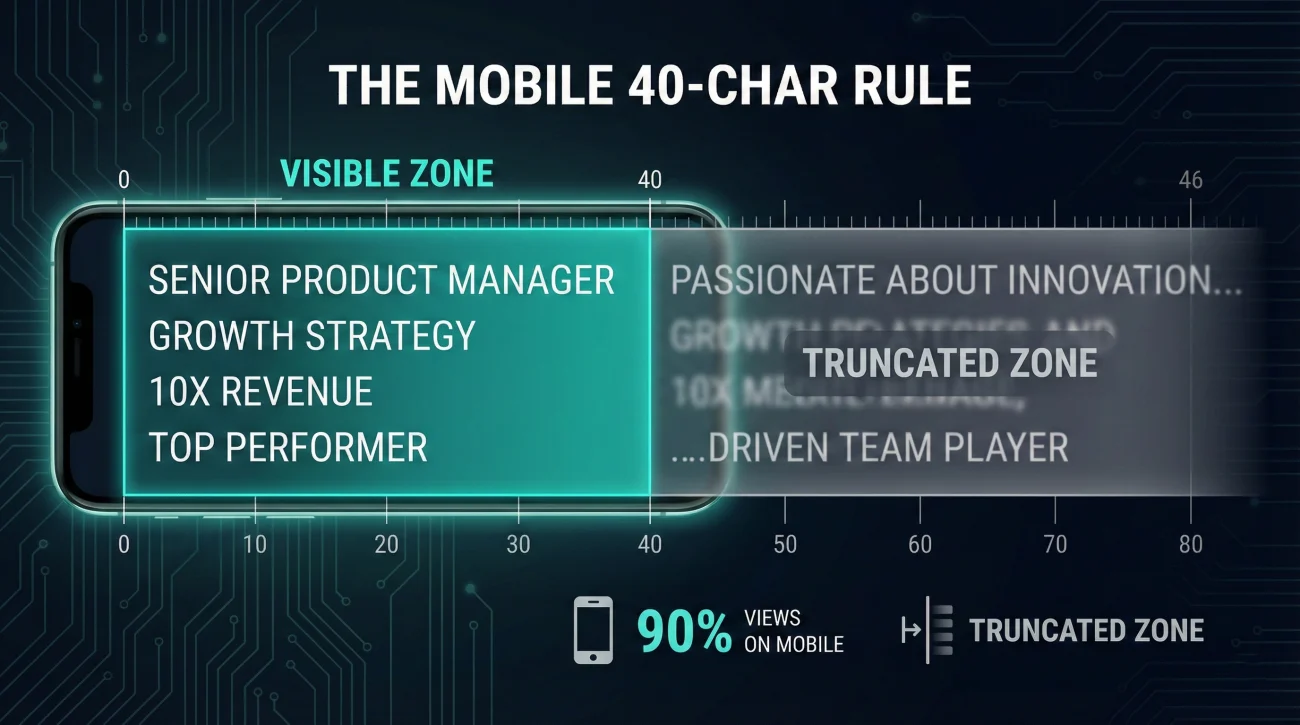
While the full headline allows 220 characters, 80% of LinkedIn usage occurs on mobile devices. In the mobile feed, only the first 40–60 characters are typically visible before the text is truncated. This necessitates a strict front-loading strategy:
1. Title and Primary Keyword: Must be in positions 1-40 (e.g., “Chief Data Scientist | MLOps & Strategy”).
2. Quantifiable Value: Positions 40-100 (e.g., “| Driving $100M+ in Supply Chain Efficiency”).
If a change breaks this mobile priority (e.g., by adding a lengthy, non-essential descriptor at the beginning), it is a high-cost error that mandates an immediate correction.
The Definitive Triggers: When a Headline Change is a Mandate

Updates should only occur when one or more of these six major strategic shifts are complete. These are mandatory triggers that signal genuine career evolution.
1️⃣ Trigger 1: Role, Promotion, or Company Change
Trigger 1: Role, Promotion, or Company Change
This is the clearest trigger. Failure to update within 48 hours of starting a new role creates a credibility gap.
🗝️ Strategic Fix: Don’t just update the title. Use the first 60 characters to highlight the impact of the new role.
Before:
“Senior Marketing Manager at OldCompany.”
After:
“Director of Demand Generation | Leading $5M Pipeline Growth at [New Company].”
2️⃣ Trigger 2: Career Pivot or New Specialization
Trigger 2: Career Pivot or New Specialization
When your functional focus changes (e.g., moving from Marketing to Product Management, or specializing your coding from Python Generalist to MLOps Engineer), your headline must reflect the new domain to capture relevant searches.
🗝️ Strategic Fix: The headline should drop the old keyword and immediately adopt the new one, dedicating significant character space to it.
Example:
“Project Manager | Certified Scrum Master | Now Focusing on Tech Product Ownership.”
3️⃣ Trigger 3: Active Job Market Entry
Trigger 3: Active Job Market Entry
When moving from passively employed to actively searching, you gain permission to adjust the headline to signal availability.
🗝️ Strategic Fix: Use subtle availability signals and refocus on transferable skills, not the current company. Never use “Unemployed” or “Seeking.” Instead, pivot to a strong skill stack.
Example:
“Head of Global Partnerships | Scaling B2B Sales Teams | Exploring Strategic Leadership Roles.”
4️⃣ Trigger 4: Major Credential or Achievement
Trigger 4: Major Credential or Achievement
If you achieve a certification that materially impacts your market value (e.g., PMP, CFA, AWS Solution Architect Pro), it must be integrated.
🗝️ Strategic Fix: Place the abbreviation upfront to leverage its authority instantly.
Example:
“CFA Charterholder | Portfolio Manager | Quantitative Strategy & Risk Management.”
5️⃣ Trigger 5: New Product or Service Launch (Freelancers/Consultants)
Trigger 5: New Product or Service Launch (Freelancers/Consultants)
For consultants, the headline is a living advertisement. If you launch a new, high-margin service (e.g., “AI Strategy Consulting” instead of “General Consulting”), update the headline to capture this premium niche immediately.
🗝️ Strategic Fix: Incorporate time-bound urgency or capacity limits.
Example:
“AI & Data Strategy Consultant | Accelerating Digital Transformation | Accepting 2 New Clients in Q1.”
6️⃣ Trigger 6: Failure to Convert (Data Mandate)
Trigger 6: Failure to Convert (Data Mandate)
If your 90-day analytics show a significant decline in Search Appearances and InMail/Profile Clicks compared to the previous period, the headline is failing its primary SEO objective. This low performance itself is a clear mandate for an immediate update, regardless of role stability.
🗝️ Strategic Fix: Conduct an immediate keyword re-audit and test a headline dominated by the highest-volume industry keywords, removing any secondary “fluff” or personal mission statements.
C-Level Governance: Handling Multiple Roles and Portfolio Careers
For senior leaders who sit on multiple boards, advise multiple startups, or manage a personal portfolio of businesses, a simple one-line headline often fails to capture their complexity and total authority. This requires a separation strategy.
1. The Headline/Role Separation Strategy
The headline should not list every role. It should list the highest-value, most authoritative, and most searchable domain you operate in.
- Headline Focus: [Highest Authority Role] | [Core Domain Expertise] | [Value/Vision]
- Experience Section Focus: List all specific roles (Board Member at X, Advisor at Y, Founder of Z).
This prevents clutter in the headline while ensuring the reader immediately grasps the C-level’s core expertise (e.g., “M&A Integration Expert,” not “Board Member at Company A, B, C”).
2. Avoiding Title Dilution
Only use the most senior title (CEO, Founder, General Partner) in the headline. Including secondary or less authoritative titles (e.g., “Mentor,” “Ambassador”) dilutes the impact of the primary role. The goal is amplification of status, not enumeration of every activity.
🔴 Example (Before): “Board Member, Advisor, Keynote Speaker, and Founder of a SaaS Startup.” (Too dilute)
🟢Example (After): “General Partner at [VC Firm] | Scaling B2B SaaS & Enterprise Strategy | Chairman, [High-Profile Board].” (High authority, domain-specific)
The 3-Step Headline Update Decision Matrix (For Managers and C-Level)
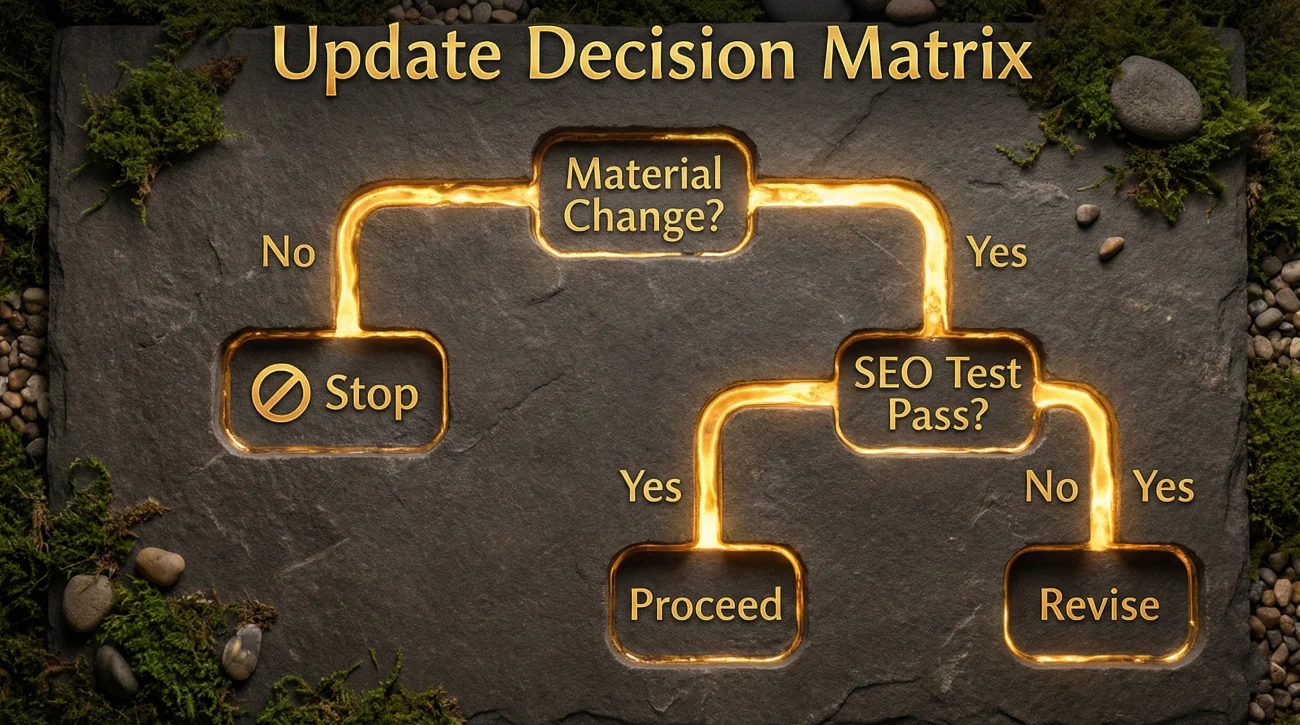
For high-stakes profiles, every update must pass a rigorous internal review. Use this framework before hitting ‘Save.’
Step 1: The Materiality Test (Why Change?)
Ask: “Has my core professional identity, functional domain, or market value increased by 20% or more since the last edit?”
- If YES (e.g., Promotion, major certification, measurable 7-figure revenue achievement): Proceed to Step 2.
- If NO (e.g., Minor wording tweak, changing a comma, chasing a new buzzword): STOP. Do not update. Stability over superficiality.
Step 2: The SEO and Readability Test (How to Change?)
Draft the new headline and test it against two competing metrics:
- SEO Relevance: Does the new version include the top 3 high-volume keywords for my target roles (e.g., “Revenue Operations,” “Kubernetes,” “ESG Reporting”)? (Use your audit list).
- Human Clarity: Can a person outside my industry understand my value proposition within 3 seconds? (Test on a non-specialist friend/colleague).
Step 3: The Governance Test (When to Deploy?)
Before deployment, complete the administrative steps:
- Activity Toggle: Did I turn OFF the “Share profile updates with your network” setting to manage the broadcast of the change? (Essential for confidential job searching or avoiding network fatigue).
- Profile Sync: Did I simultaneously update the current job title, the first two lines of the About section, and the skills list to ensure 100% consistency across the profile? (Inconsistency dilutes the authority of the headline).
The Pitfalls: Why Over-Tinkering Undermines Professional Authority
While the algorithm might not officially penalize frequent headline changes, the human element – your network – will. These common mistakes are strategic career sabotage.
Mistake 1: The Chameleon Effect (Total Repositioning)
Changing your core identity from “Product Marketing” to “Web Development” to “Executive Coach” within a few months.
🔆 The Fix: Maintain a consistent core. If a pivot is necessary, it must be staged over 6-12 months, with the headline communicating the transition (e.g., “Product Marketing | Training in Full Stack Dev | Aspiring Engineering Manager”). This manages perception.
Mistake 2: The Generic Descriptor Trap
Using vague, non-searchable phrases like “Passionate About…” or “Motivated Professional.” These waste valuable SEO character space on non-keywords and dilute your professional standing.
🔆 The Fix: Replace all passion-based nouns with verifiable, domain-specific verbs or metrics. “Passionate about Growth” becomes “Scaling ARR for B2B Tech.”
Mistake 3: The Emoji Overload
While a single, strategic emoji (like a 🚀 or 📈) can add flair in creative fields, excessive use diminishes gravitas, particularly in finance, legal, or C-suite roles. Emojis can also interfere with searchability on some legacy recruiter tools.
🔆 The Fix: Use only professionally recognized delimiters (`|`, `•`) unless your industry specifically welcomes visual flair (e.g., Design, Social Media).
Mistake 4: Relying on Default Title Automation
A fatal mistake for job seekers is allowing LinkedIn to automatically set the headline to the current job title (e.g., “Software Engineer at Google”). This wastes the 150+ characters that could be used for high-value keywords.
🔆 The Fix: Always manually override the default setting. Expand the headline to include your top 3 keywords, value proposition, and specialization. Only listing the title is a failure of marketing and SEO.
Mistake 5: Hyperbolic or Unverifiable Language
Using terms like “World-Class,” “Best-in-Industry,” or “Pioneer.” This triggers skepticism (the “too good to be true” bias). Authority comes from quantifiable facts and recognized titles, not self-proclaimed superlatives.
🔆 The Fix: Replace superlatives with numbers or verifiable certifications. “World-Class Marketer” becomes “CMO | 5X Award-Winning Campaign Strategist.”
Frequency Archetypes: Tailoring the Strategy to Your Career Stage
Should you update LinkedIn headline is determined entirely by your current career archetype. The acceptable frequency varies dramatically based on goals and perceived stability.
1️⃣ Archetype 1: Stable Corporate Executive (C-Level, VP)
Archetype 1: Stable Corporate Executive (C-Level, VP)
⌛ Frequency: Low (Every 2–3 Years, or only when changing companies/roles).
📌 Strategic Rationale: Stability equals authority. Your network needs to see you as the permanent, authoritative figure in your domain. Frequent changes create unnecessary scrutiny. The headline should be a fortress, not a playground. Focus is on thought leadership, not active search.
2️⃣ Archetype 2: Active Job Seeker or Pivot Candidate
Archetype 2: Active Job Seeker or Pivot Candidate
⌛ Frequency: Moderate to High (Every 1–3 Months).
📌 Strategic Rationale: High discoverability is the primary goal. You must continually A/B test variations to see which combination of keywords and value props triggers the most InMail messages. If a certain keyword combination fails to generate interviews over a 6-week period, it must be replaced. This is the only archetype where frequent updates are justified, provided they are data-driven experiments.
3️⃣ Archetype 3: Freelancer, Consultant, or Solopreneur
Archetype 3: Freelancer, Consultant, or Solopreneur
⌛ Frequency: Moderate (Every 3–6 Months, or per project cycle).
📌 Strategic Rationale: The headline is a lead-generation tool. Updates should align with sales cycles or service capacity. Signaling availability (e.g., “Taking on New Clients Q2”) or highlighting a major, time-bound result (e.g., “Just launched a successful 8-figure campaign for Client X”) maintains relevance and urgency. However, the core service offering should remain consistent.
4️⃣ Archetype 4: Early Career and Recent Graduates
Archetype 4: Early Career and Recent Graduates
⌛ Frequency: High (Every 3 Months).
📌 Strategic Rationale: Your professional identity is legitimately evolving rapidly. Every internship, certification, or significant project completion is a material change that warrants an update. This demonstrates momentum, ambition, and skill acquisition. This is the only stage where “showing your work” via the headline is encouraged.
Advanced Optimization: Tracking, Testing, and Profile Governance
Treat your LinkedIn headline like a critical campaign element. Its performance must be measured and optimized, aligning with LinkedIn headline best practices.
1. Tracking and Benchmarking (The 90-Day Rule)
Never change your headline and forget about it. After every material update, establish a 90-day benchmark using LinkedIn’s analytics:
- Metric A: Search Appearances: How many times did I appear in search results? (Primary SEO indicator).
- Metric B: Profile Views: How many people viewed my profile? (Primary Engagement indicator).
- Metric C: Direct Outreach: How many relevant recruiter/client InMails did I receive? (Primary Conversion indicator).
If the new headline fails to outperform the old one across these three metrics after 90 days, it is a strategic failure and must be revised immediately, making the low performance a new “Trigger 5” for an update.
2. A/B Testing Methodology for Headlines
Public, frequent A/B testing is amateur. Professionals test slowly and carefully:
- Test Variable: Only change ONE element at a time (e.g., change the Value Proposition, but keep the Title and Keywords the same).
- Duration: Minimum 6 weeks per variation to normalize for weekly fluctuations.
- Stealth Mode: Always use the “Turn Off Activity Broadcasts” feature when running a test to avoid confusing your core network.
3. Full Profile Consistency Check
The headline is the front door, but the About section is the lobby. If the headline changes, the first 2-3 lines of the About section must be synchronized. The same keywords and value proposition must be echoed there to reinforce the message and boost the overall profile SEO score. Inconsistency signals a fragmented brand.
❓ FAQ: Mastering Your Strategic Update Cadence
💰 What is the maximum character count and why does mobile view matter?
🔄 Is it bad to change headline often if I’m only changing keywords?
💼 If I am employed, how can I test new headlines for job searching confidentially?
📈 How do I know if my old headline was better than my new one?
🔗 Should I include my personal mission statement or philosophy in the headline?
🛡️ Is there a way to roll back a headline change if it fails?
Final Governance Summary: Prioritizing Clarity Over Cleverness
The ultimate goal of governing your LinkedIn headline is to ensure it is a reflection of your professional truth – your current role, your current value, and your current career trajectory. This isn’t about arbitrary time intervals or chasing the latest trend; it is about respecting the professional capital you have built.
The successful professional understands that stability is a source of trust, and the decision to update is a strategic maneuver, not a whim. By adhering to a rigorous framework that requires a material trigger (promotion, pivot, SEO audit) and a data-driven check (the 90-day benchmark), you move from reactive profile management to proactive career governance.
Your headline must be an asset that works for you 24/7 – a clear, concise, and searchable statement that eliminates all ambiguity about your value. Update only when necessary, audit regularly, and always ensure that every character serves your highest professional objective. The clarity you project in your headline is the clarity you will receive in return from your network and potential opportunities. For more examples and further refinement, consult our definitive LinkedIn headline examples tailored to specific professions.
If you like practical, no-fluff advice like this, you’ll find more of it on the ProfileHeadline blog.