
- CTA Decision: Your headline is a mini landing page, so a CTA is a trade where you give up a bit of status to gain clarity and inbound action.
- Signal Types: Use “Hunter” CTAs for fast leads and volume, use “Magnet” positioning to keep authority and filter for high-quality opportunities.
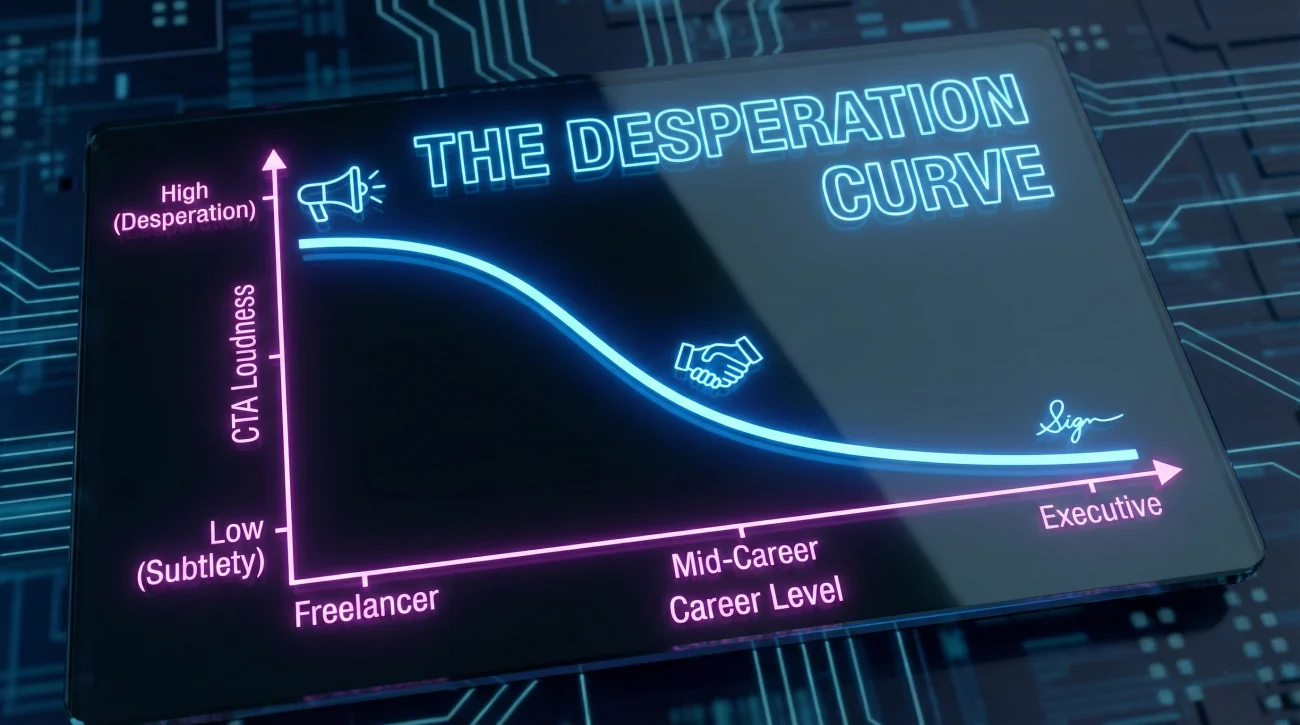
- Career Fit: Follow the “Desperation Curve” where freelancers can be loud, job seekers must be measured, founders invite partnership, executives stay mostly silent.
- Execution Rules: Put the CTA at the end, avoid cringe or needy wording, and match the CTA style to your industry norms and buyer psychology.
- Validation: Run a 14-day test using a traffic-light check on messages, view quality, and conversion signals, then keep, refine, or remove the CTA based on results.
The Art of the Ask: Mastering Strategic Calls-to-Action in LinkedIn Headlines
In the high-stakes real estate of your LinkedIn headline, every character equates to currency. With a hard limit of 220 characters to define your entire professional existence, deciding to dedicate 15-20 of them to a Call-to-Action (CTA) is not merely a writing choice; it is a strategic investment decision. Get it right, and you open a floodgate of high-quality inbound leads, effortlessly filtering out the noise. Get it wrong, and you immediately signal desperation, devaluing your personal brand before a recruiter or client even clicks your profile.
Most professionals fundamentally misunderstand the function of a headline CTA. They treat it as a polite sign-off – a digital equivalent of “Have a nice day!” – using generic phrases like “Let’s connect!” or “Open to networking.” This is a wasted opportunity. In a crowded marketplace, your headline is not a business card; it is a landing page. And like any high-converting landing page, it requires a mechanism to convert passive attention into active engagement.
This comprehensive guide dismantles the binary thinking of “should I or shouldn’t I include a CTA” and replaces it with a nuanced, multi-dimensional framework based on Leverage, Intent, and Status Signaling. We will explore the “Desperation Curve,” analyzing why a CTA that drives revenue for a Freelance Copywriter can be career suicide for a Fortune 500 Executive. We will provide over 50 engineered scripts that convert passive scrollers into active conversations, and we will establish the rigorous metrics you need to track to ensure your “ask” isn’t costing you priceless opportunities.
The Psychology of the “Ask”: Decoding Status Signals

Before writing a single word, you must understand the invisible psychological game being played. In negotiation theory and evolutionary psychology, the party that explicitly asks for the meeting usually holds less perceived power (Status) than the party granting it. This dynamic applies directly to LinkedIn’s digital ecosystem.
When you add a CTA, you are pulling a psychological lever. You are trading a small amount of “Status” (perceived exclusivity) for a large amount of “Clarity” (ease of access). Understanding this trade-off is the key to mastering the headline.
Signaling Theory in Practice
Every element of your headline sends a signal about your market value. We can categorize CTAs into two distinct signal types:
1. The Hunter Signal (High Clarity, Lower Status)
Examples:
“DM me for rates,” “Open to work,” “Let’s build together.”
This signals: “I am hungry. I have excess capacity. I am actively looking for transactions.”
- The Upside: It drastically reduces friction. A potential buyer knows exactly how to engage with you. It filters out people who aren’t ready to buy.
- The Downside: It removes the allure of exclusivity. In premium markets (like high-end consulting or executive search), availability can sometimes be mistaken for lack of demand.
- Best For: Sales professionals, Freelancers, Agency Owners, and Active Job Seekers who prioritize volume of leads over brand mystique.
2. The Magnet Signal (High Status, Higher Friction)
Examples:
“Helping F500 CEOs scale,” “Building the future of FinTech,” “Speaker,” “Author.”
This signals: “I am busy. I am in demand. I provide value. If you want me, you have to do the work to find me.”
- The Upside: It preserves high status. It implies that you are so busy delivering results that you don’t have time to beg for connections. This attracts high-quality peers who respect authority.
- The Downside: It creates friction. A lazy (but potentially valuable) lead might scroll past because they aren’t sure if you are open to consulting.
- Best For: C-Suite Executives, Investors, Thought Leaders, and Passive Candidates who only want to be bothered for “unicorn” opportunities.
| Dimension | Explicit CTA (Hunter) | Implicit CTA (Magnet) |
|---|---|---|
| Primary Goal | Volume of Leads / Quick Conversion | Brand Authority / Quality Filtering |
| Psychological Trigger | Ease of Access (Convenience) | Scarcity (Fear Of Missing Out) |
| Risk Factor | Can appear “Salesy” or Desperate | Can appear Unapproachable or Arrogant |
| Conversion Speed | Fast (Direct Action) | Slow (Relationship Building) |
The “Desperation Curve”: A Strategic Framework for Your Career Stage
Your career stage dictates your CTA strategy. We can map this on a spectrum we call the “Desperation Curve.” As a general rule, the higher up the corporate ladder you go, the quieter and more subtle your CTA should become. Violating this curve creates a dissonance that confuses recruiters and clients.
1️⃣ Scenario 1: The Freelancer & Solopreneur (The Loudest Ask)
Scenario 1: The Freelancer & Solopreneur (The Loudest Ask)
Context: You eat what you kill. Your LinkedIn profile is your primary sales funnel. You cannot afford to be subtle.
The Strategy: Be transactional. Use “Direct Response” copywriting techniques. You want clients to know exactly what you sell and how to buy it immediately.
The Mistake: Being vague (“Helping businesses grow”). This tells me nothing about how to hire you.
The Fix: Create urgency and specificity.
Winning Formula:
[Niche Expert] | [Specific Result] | [Availability/Scarcity Signal].
Example:
“SaaS Copywriter | 3x Your Landing Page Conversions | 2 Audit Slots Open for April“
💡 Why it works: “2 Slots Open” implies scarcity, while “Audit” implies a specific product, not just “chatting.”
2️⃣ Scenario 2: The Active Job Seeker (The Calculated Ask)
Scenario 2: The Active Job Seeker (The Calculated Ask)
Context: You need a job, but you don’t want to look like you need a job. You need to balance visibility with dignity.
The Strategy: Use professional availability markers. You are a valuable asset on the market, not a distressed asset on clearance.
The Mistake: “Desperately looking for work! Please hire me!” This triggers a subconscious “something is wrong with this candidate” bias in recruiters.
The Fix: Frame your availability as an opportunity for them.
Winning Formula:
[Role] | [Top Skills] | [Value Add] | [Open to X Roles]
Example:
“Senior Project Manager | Agile & Scrum | Delivered $10M Projects | Open to Remote Leadership Roles”
💡 Why it works: It specifies “Remote Leadership Roles,” showing you have standards and aren’t just taking anything.
3️⃣ Scenario 3: The Founder (The Partnership Ask)
Scenario 3: The Founder (The Partnership Ask)
Context: You aren’t looking for a job; you are looking for investors, co-founders, or beta users. You are selling a vision.
The Strategy: Invite collaboration. Your CTA should feel like an exclusive invitation to a club.
The Mistake: Treating LinkedIn like a cold email (“Buy my product”).
The Fix: Focus on the ecosystem (Hiring, Testing, Partnering).
Example:
“Founder @ TechStart | Revolutionizing EdTech | Hiring Engineers & Seeking Beta Testers”
💡 Why it works: It signals growth (“Hiring”) which attracts investors, while simultaneously finding users.
4️⃣ Scenario 4: The Executive (The Silent Ask)
Scenario 4: The Executive (The Silent Ask)
Context: You are a VP, Director, or C-Suite leader. Your currency is authority and network quality.
The Strategy: Silence. No CTA is the best CTA. Your title is the hook.
The Logic: If you are the VP of Engineering at Google, you do not ask people to “connect.” People line up to connect with you. Adding a CTA lowers your status to that of a networker rather than a leader.
Example:
“VP of Engineering at Google | Building World-Class AI Teams.”
💡 Why it works: The lack of a CTA implies: “I am busy building. If you have something valuable, you will find a way to reach me.”
Industry Playbooks: Tailoring Your CTA to Your Niche
A CTA that works in Tech will fail in Finance. Here is a breakdown of industry-specific nuances.

💻 The Tech Playbook (Developers, PMs, Data)
Tech culture values Open Source, collaboration, and specific stacks. Your CTA should reflect “Community.”
- ✅ “Contributor to React Docs | Let’s chat Open Source“
- ✅ “Building AI Agents | Dm to discuss LLMs“
- ✅ “Python Specialist | Check my GitHub link below“
💰 The Sales & Marketing Playbook
You are judged by your ability to sell. If your headline can’t sell you, how can you sell a product? Be bold.
- ✅ “Helping B2B SaaS Scale to $10M | Dm ‘SCALE’ for case studies“
- ✅ “Account Executive | Let’s talk about your Q4 goals“
- ✅ “Growth Marketer | Steal my SEO checklist 👇“
🎨 The Creative Playbook (Designers, Writers)
Your portfolio is everything. Your CTA must drive traffic to your visual proof.
- ✅ “Brand Designer | See my portfolio in Featured Section“
- ✅ “UX Researcher | Booking freelance projects for May“
- ✅ “Video Editor | Watch my latest reel ⬇️“
📈 The Finance & Legal Playbook
Trust and discretion are paramount. Avoid anything “flashy.” Use “Advisory” language.
- ✅ “CPA for Tech Startups | Accepting Advisory Clients“
- ✅ “M&A Attorney | Confidential Consultations Available“
- ✅ “Wealth Manager | Helping Founders Exit” (Implicit CTA)
The Copy-Paste Vault: 50+ High-Converting CTA Scripts
Stop guessing. Here is a massive library of tested CTA fragments categorized by intent. Plug these into the end of your headline.
For Generating Leads (Aggressive to Subtle)
High Aggression (Direct Sales):
- 👉 “DM ‘GROWTH’ for a free audit”
- 👉 “Book your 15-min strategy call ⬇️”
- 👉 “Only 2 client spots left for Q3”
- 👉 “Click the link in bio to start”
Medium Aggression (Consultative):
- 👉 “Accepting new clients for 2025”
- 👉 “DM to discuss your project”
- 👉 “Available for fractional roles”
- 👉 “Let’s optimize your ad spend”
Low Aggression (Inbound):
- 👉 “See my portfolio in Featured section”
- 👉 “Case studies available upon request”
- 👉 “Helping brands via [Agency Name]”
For Network Growth (Creators/Thought Leaders)
- 👉 “Follow for daily AI tips”
- 👉 “Hit the 🔔 for updates”
- 👉 “Posting daily about Sales Engineering”
- 👉 “Join 50k+ subscribers in my newsletter”
- 👉 “Let’s talk FinTech trends”
- 👉 “Connecting with fellow Founders”
- 👉 “Always happy to chat crypto”
For Recruiters (Hiring Managers)
- 👉 “We are Hiring! Apply below”
- 👉 “Looking for top 1% React Devs”
- 👉 “Join our rocketship 🚀”
- 👉 “DM me to join the team”
- 👉 “Building the best team in SaaS”
- 👉 “Hiring aggressively in Austin”
For Job Seekers (Active to Passive)
Active (Unemployed/Immediate):
- 👉 “Available for immediate start”
- 👉 “Open to Full-time & Contract roles”
- 👉 “Seeking new opportunities in HealthTech”
- 👉 “Ready for my next challenge”
Passive (Employed/Looking):
- 👉 “Open to interesting conversations”
- 👉 “Always exploring new challenges”
- 👉 “Let’s connect” (Simple, classic)
- 👉 “Open to Board roles”
The “Cringe List”: 5 CTA Mistakes Killing Your Credibility
Avoid these at all costs. They trigger an immediate “ignore” reflex in the human brain.
| The Mistake | Why It Fails | The Fix |
|---|---|---|
| The “Beggar” “Please connect, I need a network!” | Projects zero value. Networking is a value exchange, not a donation. It smells of neediness. | “Connecting with fellow Data Scientists to share insights.” |
| The “Guru” “DM me to change your life.” | Sounds like a pyramid scheme or a scam. High skepticism trigger. | “Helping X achieve Y result.” (Be specific) |
| The “Vaguebooker” “Let’s chat.” | Chat about what? The weather? My time is expensive. Don’t make me guess. | “Let’s chat about Cloud Architecture.” |
| The “All Caps” “HIRE ME NOW!!!” | Equivalent to screaming in a library. It looks unstable and unprofessional. | “Available for immediate start.” |
| The “Wrong Door” “Email me at name@gmail…” | Headline text is not copy-paste friendly on mobile. Friction is too high. | “Contact info in bio.” or “See Contact Info.” |
Data-Driven Validation: The “Traffic Light” System
Subjective feelings have no place in optimization. Don’t rely on intuition. Use the “Traffic Light” testing method to validate your CTA effectiveness over a 14-day sprint.

How to Setup the Test
- Day 0: Screenshot your Profile Views and “Search Appearances” stats.
- Day 1: Change ONLY the CTA part of your headline. Keep the title/skills the same.
- Day 1-14: Do not change your profile picture or banner. This isolates the variable.
- Day 15: Review the metrics.
🟢 Green Light (It’s Working)
- Metric: Inbound messages mention your CTA topic specifically (e.g., “Hi, I saw you’re open to audits…”).
- Metric: Connection acceptance rate increases.
- Action: Double down. Move the CTA earlier in the headline if possible (e.g., move from end to middle).
🟡 Yellow Light (False Positive)
- Metric: Profile views go up, but connection requests are generic, spammy, or from irrelevant people.
- Diagnosis: Your CTA is too broad (“Let’s connect”). You are attracting quantity, not quality.
- Action: Niche down. Change “Let’s connect” to “Connecting with SaaS Founders” or “Open to Senior Roles only.”
🔴 Red Light (Stop Immediately)
- Metric: Profile views drop, or you receive zero messages in 14 days.
- Diagnosis: Your CTA is creating friction or “The Ick” (appearing desperate).
- Action: Remove the CTA entirely. Revert to pure value positioning (Implicit CTA) for 2 weeks to reset the baseline.
❓ FAQ
📝 Should I put the CTA at the beginning or end of the headline?
🎨 Can I use emojis in my CTA?
🚫 When should I REMOVE a CTA?
🔗 Can I put a URL in my headline?
🤔 My CTA is “Open to Networking” but no one messages me. Why?
Final Thoughts: The Silent Power of “No”
The most powerful negotiation stance is the ability to walk away. Sometimes, the most strategic CTA is the one you don’t write.
If you are established, confident, and highly skilled, your entire profile acts as a CTA. You don’t need to ask people to connect; the quality of your insights makes connection inevitable. Use explicit CTAs as a tool for specific seasons of growth – launching a product, filling a pipeline, seeking a role – but do not let them become a permanent crutch.
Audit your headline today. Is your CTA serving a business goal, or is it just filling space? If it’s not converting, kill it. Silence is louder than noise.
For more on structuring the rest of your narrative, let check our Blog or review our pillar on comprehensive headline strategy.