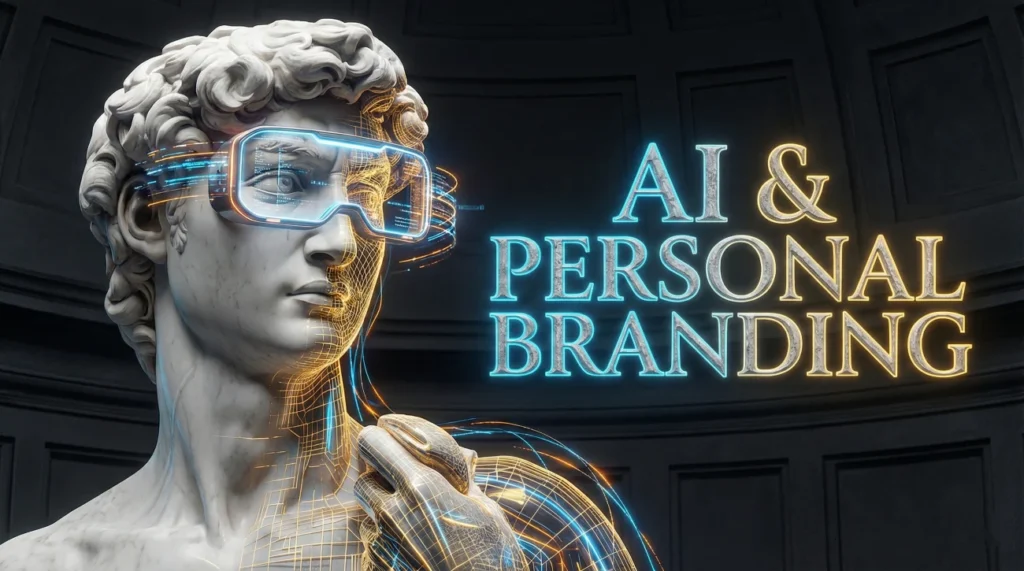
- AI headline paradox: AI makes profiles sound identical, so use it as a strategic partner to find the pattern and break it, not as a generic content generator.
- Recruiter click psychology: A headline is a 220-character hook, and “safe” AI language becomes noise, so you need specific signals that act as a pattern interrupt.
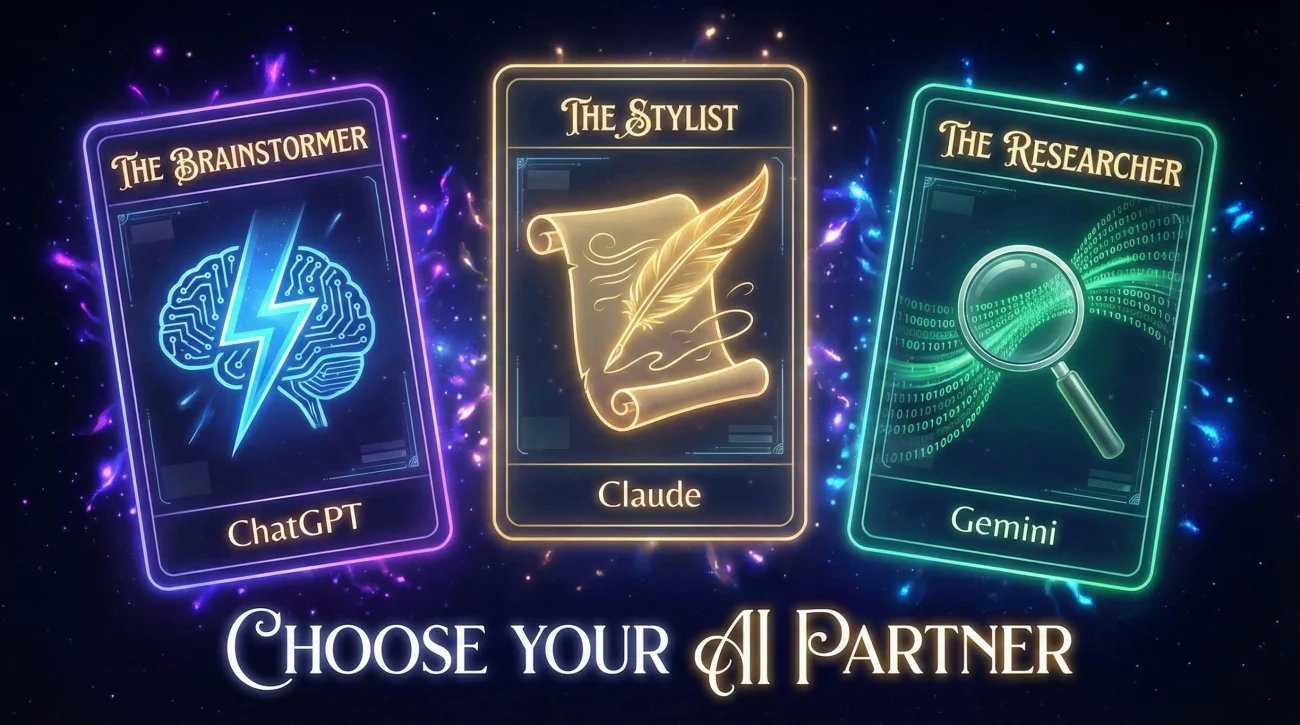
- Tool roles by strength: ChatGPT for fast brainstorming, Claude for natural tone and constraint-following, Gemini for live keyword and competitor research.
- Prompt workflow that works: Start with gap analysis, draft value propositions around outcomes, inject keywords without stuffing, then run a skeptical recruiter simulation to stress-test.
- Validation and iteration: Use the Human – AI – Human sandwich, polish out the “AI accent,” and measure impact with a 14-day minimum test using search appearances and profile views.
Beyond the Hype: Mastering AI Tools for LinkedIn Headline Optimization
In the rapidly evolving landscape of professional branding, artificial intelligence has shifted from a novelty to a necessity. However, a cursory glance at LinkedIn today reveals a troubling trend: a sea of profiles that sound suspiciously identical. They use the same buzzwords (“passionate about,” “unlocking potential,” “navigating the complex landscape”), follow the same rigid structures, and lack the nuances that make a personal brand truly personal.
This homogeneity creates a paradox: as tools become more accessible, standing out becomes harder. When everyone has access to a Ferrari, the driver’s skill becomes the only differentiator. To truly stand out, you must stop treating AI as a “content generator” (a machine that spits out text) and start treating it as a “strategic partner” (a consultant that challenges your thinking).
This guide goes far beyond basic prompting. We will dismantle the mechanics of AI tools for LinkedIn headline creation, exploring how to leverage Large Language Models (LLMs) to analyze competitive gaps, engineered distinct positioning, and refine your professional hook without losing your authentic voice. We will explore the psychology behind what makes a recruiter click, the algorithmic implications of your word choice, and the specific workflows that separate the top 1% of profiles from the rest.
Whether you are a job seeker aiming to bypass Applicant Tracking Systems (ATS) or a consultant looking to attract high-ticket clients, the strategy remains the same: AI provides the logic; you provide the soul. Let’s dive deep into how to orchestrate this collaboration effectively.
The Psychology of the Click: Why AI Often Misses the Mark
Before we touch the tools, we must understand the battlefield. A LinkedIn headline is not just a summary; it is a marketing hook confined to 220 characters. When a human recruiter scans a search result page, their brain makes a judgment in approximately 0.4 seconds. They are looking for “Signal” amidst “Noise.”
The Problem with “Default” AI: Standard AI models are trained to predict the most probable next word. In the context of LinkedIn, the “most probable” word is often the most average, safe, and overused word. If you ask ChatGPT to “write a professional headline,” it defaults to corporate-speak because that is the statistically dominant language in its training data. This results in “Noise.”
The “Pattern Interrupt” Strategy: To win, your headline must act as a Pattern Interrupt. It needs to look slightly different, sound more specific, or offer a clearer value proposition than the profiles above and below you. We use AI not to blend in, but to identify the pattern so we can strategically break it.
The Strategic Landscape: Choosing the Best AI Writer for Headline Creation
Not all AI models are created equal. While the underlying technology (Transformers) is similar, the fine-tuning of each model dictates its specific strengths in professional writing. Understanding the “personality” of each tool is the first step toward optimization.
ChatGPT (OpenAI): The Creative Brainstorming Engine
ChatGPT (particularly the GPT-4o model) excels at lateral thinking. It is the best ai writer for headline brainstorming because it can generate volume quickly. If you are stuck and staring at a blank page, ChatGPT acts as an uninhibited editor, throwing 20 ideas at the wall to see what sticks. Its primary weakness is a tendency toward verbosity and clichés. Without strict constraints, it loves words like “tapestry,” “symphony,” “delve,” and “transformative.” It often hallucinates a level of enthusiasm that feels fake to human readers.
💡 Pro Tip: Use ChatGPT to generate analogies. Ask: “Describe my role as a Project Manager using a metaphor related to an orchestra conductor.” This often yields fresher hooks than standard prompts.
Claude (Anthropic): The Tonal Stylist
For professionals who are concerned about sounding “robotic,” Claude (specifically Claude 3.5 Sonnet) is the superior choice. It has a more natural, human-like baseline tone and follows complex stylistic instructions better than its competitors. Claude is less likely to hallucinate facts and more likely to adhere to specific character counts – a crucial factor for the strict limits of a LinkedIn headline. It tends to be more concise and less flowery, often preferring direct statements over adjectives.
💡 Pro Tip: Upload your resume and a sample of your actual writing to Claude and ask it to “capture my voice.” It adapts significantly better than GPT.
Google Gemini: The SEO & Market Researcher
Gemini’s superpower is its connection to Google’s live index. While other tools rely on training data cut-offs, Gemini can “see” the current web. This makes it indispensable for researching current keywords and analyzing real-time competitor profiles. It brings a data-driven edge to your headline strategy that purely creative models lack. If you need to know what skills are trending this month in your industry, Gemini is the only reliable source.
To help you select the right tool for your specific phase of optimization, consult the comparison below:
| Feature / Capability | ChatGPT (GPT-4) | Claude (3.5 Sonnet) | Google Gemini |
|---|---|---|---|
| Creative Ideation | ⭐⭐⭐⭐⭐ | ⭐⭐⭐⭐ | ⭐⭐⭐ |
| Human-like Tone | ⭐⭐⭐ | ⭐⭐⭐⭐⭐ | ⭐⭐⭐ |
| SEO & Trend Data | ⭐⭐ | ⭐⭐ | ⭐⭐⭐⭐⭐ |
| Instruction Following | ⭐⭐⭐⭐ | ⭐⭐⭐⭐⭐ | ⭐⭐⭐⭐ |
| Adherence to Constraints | ⭐⭐⭐ | ⭐⭐⭐⭐⭐ | ⭐⭐⭐⭐ |
| Best Use Case | Volume & Variations | Refinement & Style | Keywords & Research |
Advanced Engineering: Gemini Prompts for LinkedIn Profile Optimization
The quality of your output is mathematically proportional to the quality of your input (garbage in, garbage out). Most users fail because they use “Zero-shot” prompts like “Write a LinkedIn headline for a Project Manager.” This results in generic fluff. To achieve authority, we must use “Few-Shot Chain of Thought” prompting. This technique involves giving the AI a role, specific context, examples of success, and a constraint list.
Below are engineered Gemini prompts for LinkedIn profile workflows designed for specific strategic outcomes.

1. The “Gap Analysis” Prompt (Market Research)
Before writing, you need to understand where you fit in the market. Use Gemini’s live data capability for this. We aren’t asking for a headline yet; we are asking for intelligence.
**Role**: You are a Senior Executive Recruiter specializing in [Insert Industry, e.g., Fintech] with 15 years of experience placing candidates at Tier-1 firms.

**Task**: Analyze the current market trends for [Insert Job Title] roles. I want you to:

- Identify the top 5 hard skills that are currently in highest demand for this role in 2024/2025 (ignore soft skills like "leadership").
- List 3 specific "pain points" that companies are trying to solve when hiring for this position (e.g., reducing cloud costs, improving retention).
- Search for 3 profiles of "Top Voices" or industry leaders in this niche and analyze their headline structures. What patterns do they use?

**Output**: Provide specific bullet points only. Do not generate a headline for me yet. I need the raw data first to inform my strategy.
2. The “Value Proposition” Generator (Drafting)
Once you have the data from step 1, use Claude or ChatGPT to draft the narrative. This prompt focuses on distinguishing you from peers by forcing the AI to focus on outcomes rather than duties.
**Context**: I am a [Current Role] with [Number] years of experience. Based on the research, my core strength is [Unique Selling Point, e.g., turning around failing engineering teams].

**Target Audience**: CTOs and VPs of Engineering at Series B Startups who are struggling with scaling issues.

**Constraint**: Write 10 headline variations. Each must be under 220 characters.

Negative Constraints (CRITICAL): Do NOT use buzzwords like "unleashing," "synergy," "guru," "ninja," "enthusiast," or "passionate about." Do not use complete sentences. Use pipes (|) or bullets to separate ideas.

**Structure Options**:

- Option A (The Expert): Title | Hard Skill | Hard Skill | Big Achievement
- Option B (The Solver): Helping [Target Audience] solve [Problem] via [Solution]
- Option C (The Hybrid): Title @ Company | Unique Value Proposition
3. The Keyword Injection Protocol (Optimization)
This is where most people ruin their headlines by “stuffing” keywords. We want natural integration. We will ask the AI to act as an SEO specialist.
**Input**: Here is my draft headline: "[Insert Draft from Step 2]".

**SEO Goal**: I need to rank for these keywords: [List Keywords from Gemini research].

**Task**: Rewrite the draft to include the primary keyword near the beginning (front-loading) and secondary keywords towards the end. Ensure the grammar remains perfect. Do not sacrifice readability for SEO. The headline must still be readable by a human.

**Tone Check**: Ensure it does not sound spammy.
4. The “Recruiter Simulation” (Validation)
Finally, we test the output before going live. This is a “Red Team” exercise where the AI critiques its own work.
**Role**: Act as a skeptical Hiring Manager at a Fortune 500 company. You are reviewing hundreds of profiles.

**Input**: I am showing you this headline: "[Insert Final Candidate]".

**Question**:

- Based ONLY on this headline, what do you assume is my biggest strength?
- What is the biggest "red flag" or vague term in this headline?
- Would you click this profile if you were looking for a senior leader? Why or why not?
The “Sandwich Method”: How to Integrate AI Into LinkedIn Strategy
The most effective workflow for how to integrate AI into LinkedIn strategy is the “Human-AI-Human” sandwich. You start the process (Human), AI accelerates the middle (AI), and you finish the polish (Human). Relying solely on AI creates a “synthetic” feel that recruiters can smell from a mile away.
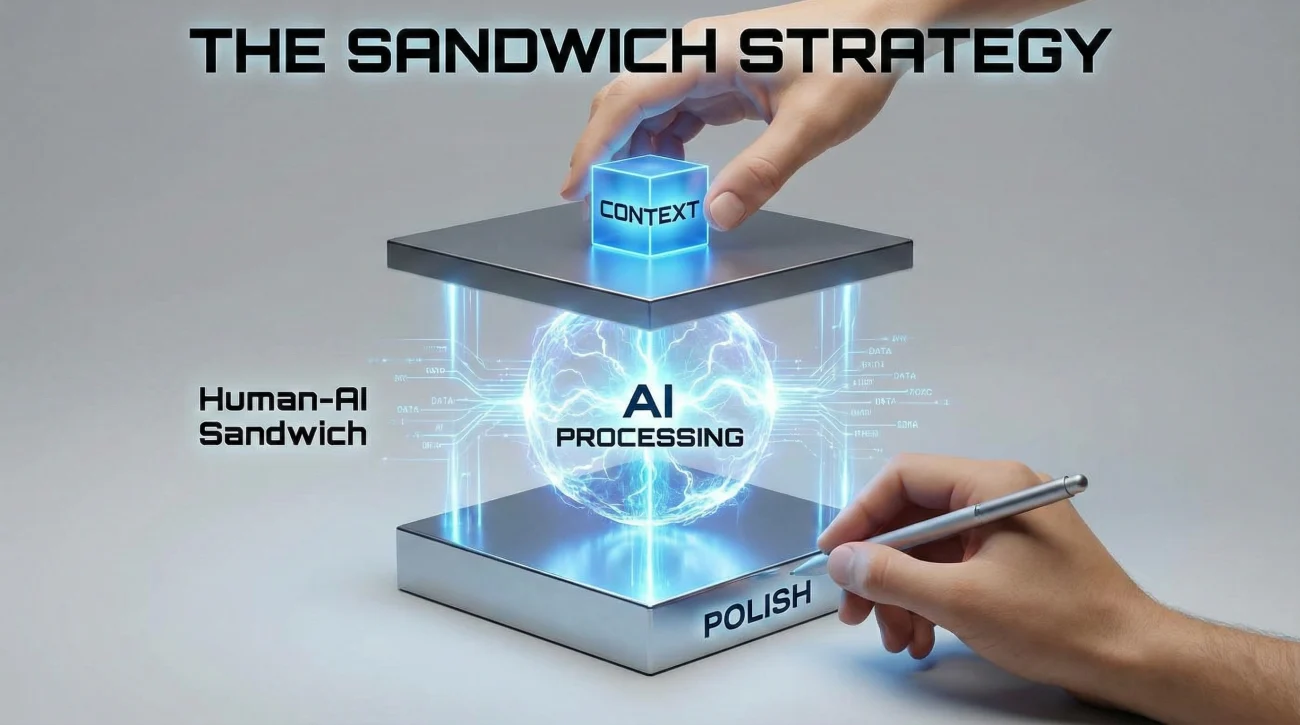
Layer 1: Human Context (The Brief)
AI cannot know your career highlights unless you feed them into the system. Before opening a chat window, audit your own career. Identify the “metrics that matter.”
- Quantifiable Impact: Did you save money? How much? Did you lead a team? How large? Did you launch a product? What was the revenue impact?
- Soft Power: What do colleagues come to you for? (e.g., “Calming down angry clients” vs. “Technical troubleshooting”).
- The “Why”: Why do you do this job? This helps in crafting the “Personal Voice.”
Strategy Tip: AI thrives on specificity. “Managed a team” is weak input. “Managed a cross-functional team of 15 developers across 3 time zones” is strong input. The more granular your data, the less generic the AI’s output.
Layer 2: AI Iteration (The Grunt Work)
Use the tools to generate volume. Ask for 20 variations. Never settle for the first response. The first response is usually the most cliché because it’s the most probable.
Mix and Match Technique: Treat the AI outputs as a “parts bin.” Maybe you like the opening hook of Option #3 (“SaaS Growth Architect”) but prefer the keyword listing of Option #7 (“Python | React | AWS”). You are the chef; the AI is just the sous-chef chopping the vegetables. Assemble the final dish yourself.
During this phase, use AI to check for clarity. Ask: “Review this headline from the perspective of a skeptical hiring manager. What is vague? What sounds like fluff?”
Layer 3: Human Polish (The Soul)
This is the non-negotiable step. You must manually edit the final output. Remove the “AI accent.”
| Pros of AI Drafting | Cons of Unedited AI |
|---|---|
| ✅ Eliminates writer’s block instantly. | ❌ Overuses emojis and hashtags (🚀, ✨, #OpenToWork). |
| ✅ Suggests keywords you might have missed. | ❌ Lacks cultural nuance and industry-specific slang. |
| ✅ perfectly calculates character limits. | ❌ Can sound arrogant or disconnected from reality. |
| ✅ Offers objective A/B testing options. | ❌ Hallucinates skills you don’t actually possess. |
Your final check should be the “Bar Test”: If you said this headline out loud to a stranger at a bar, would they understand what you do, or would they think you are a robot? If it’s the latter, rewrite it. A headline like “Navigating the intersection of technology and humanity” fails the Bar Test. “Software Engineer building HealthTech apps” passes.
Data-Driven Validation: AI Headline Testing Protocols

Subjective feelings have no place in optimization. You might “like” a headline, but does the market respond to it? AI headline testing requires a scientific approach.
The 4-Week Sprint
Do not change your headline daily. LinkedIn’s algorithm takes time to re-index your profile and serve it to new audiences. Commit to a headline for at least 14 days to filter out daily noise.
- Baseline Measurement (Week 0): Record your “Search Appearances” and “Profile Views” (found in your LinkedIn dashboard). Take a screenshot. Note the specific keywords you are currently ranking for.
- The Variable (Week 1-2): Upload the new AI-optimized headline. Change nothing else on your profile. If you change your photo, banner, and headline at the same time, you won’t know which one caused the spike (or drop). This is basic scientific isolation.
- Analysis (Week 3): Compare the data. Did search appearances go up? More importantly, look at the “Keywords your searchers used” section in the analytics. Are the keywords relevant? If appearances go up but keywords are irrelevant (e.g., you are a Developer but ranking for “Sales”), your headline is misleading.
The “Glance Test”
Ask AI to simulate a recruiter. Paste your new headline into a fresh chat window and ask:
"Based ONLY on this headline, what do you assume are my top 3 skills and what seniority level am I? Be brutally honest."
If the AI guesses wrong (e.g., assumes you are junior when you are a Director), your positioning is off. Refine immediately. Additionally, ask 3 peers in your industry to review it. AI can predict algorithms, but only humans can predict “cringe.”
For a deeper dive on structuring these elements, refer to our guide on categorized headline examples.
❓ FAQ
🤖 Will using AI for my LinkedIn headline get me penalized by the algorithm?
💰 Is the paid version of ChatGPT worth it for profile optimization?
📏 What is the ideal character count for a headline in 2025?
🔍 How often should I update my headline using AI?
⛔ What are the “red flag” words AI loves that I should delete?
🧠 How do I train the AI to sound like me?
Final Thoughts: The Future of Personal Branding
We are entering an era where AI literacy is a soft skill. Using tools like ChatGPT, Claude, and Gemini to optimize your LinkedIn profile is no longer a “hack” – it is standard operating procedure for high-performers. The barrier to entry for creating a “good enough” profile has dropped to zero.
However, the differentiator is no longer who uses AI, but how it is used. The winners will be those who use these tools to amplify their authentic voice, not replace it. They will use Gemini for deep research, Claude for tonal precision, and their own strategic judgment for the final cut.
Your LinkedIn headline is the most valuable digital real estate you own. It is the only thing people see before they click. Don’t let a generic algorithm dictate its value. Take control of the prompt, audit the output with human eyes, and test it with real data. The future of personal branding isn’t about being better than AI; it’s about being more human than everyone else who is using AI lazily.
To continue building your profile authority, read our comprehensive pillar on LinkedIn headline strategy. If this was helpful, you’ll probably enjoy the rest of the articles on our Blog.