

- The “Imposter Tax” problem: When you downplay your title or skills, you feed bad data to search and recruiters, so you become invisible to the right roles.
- Accuracy beats arrogance: Use factual proof (scope, numbers, credentials) as neutral labeling, not hype words like “guru” or “best”.
- Delete minimizers fast: Remove “Aspiring”, “Just”, “Enthusiast”, “Helping”, “Student of” because they signal low confidence and low value.
- Match your imposter archetype: Use tailored headline scripts for career changers, juniors, humble experts, and generalists so your positioning stays credible.
- Evidence-based confidence framework: Audit your work, convert tasks into outcomes, then build a headline that leads with role + proof + searchable skills.
The Silent Career Killer: Rewriting Your Narrative Without the Imposter Tax
There is a tax on your career that doesn’t appear on any pay stub. It is the “Imposter Tax” – the cost of opportunities lost because you felt unqualified to claim them. You stare at the LinkedIn headline field, and a voice in your head says: “Who am I to call myself an Expert? I’m just doing my job.”
Understanding how to write a headline without imposter syndrome is not about “faking it until you make it.” It is about correcting a data error. Imposter Syndrome is essentially a “reporting bias”: you undervalue your own assets while overvaluing everyone else’s. When you downgrade your title from “Senior Project Manager” to “Project Coordinator” out of modesty, you are not being humble; you are feeding false data to the search algorithm. You are making yourself invisible to the very people who need your help.
This comprehensive guide is a psychological and tactical intervention. We will dismantle the linguistic habits of self-sabotage (“Just,” “Aspiring,” “Trying”). We will provide a framework for Evidence-Based Confidence – a way to state your worth that relies on cold, hard facts rather than subjective ego. Whether you are a career changer, a junior employee, or a senior leader battling inner doubt, this playbook will give you the permission structure to claim your space.
The Psychology of “Toxic Humility”: Arrogance vs. Accuracy
High achievers often confuse “Accuracy” with “Arrogance.” Let’s draw a hard line between the two.
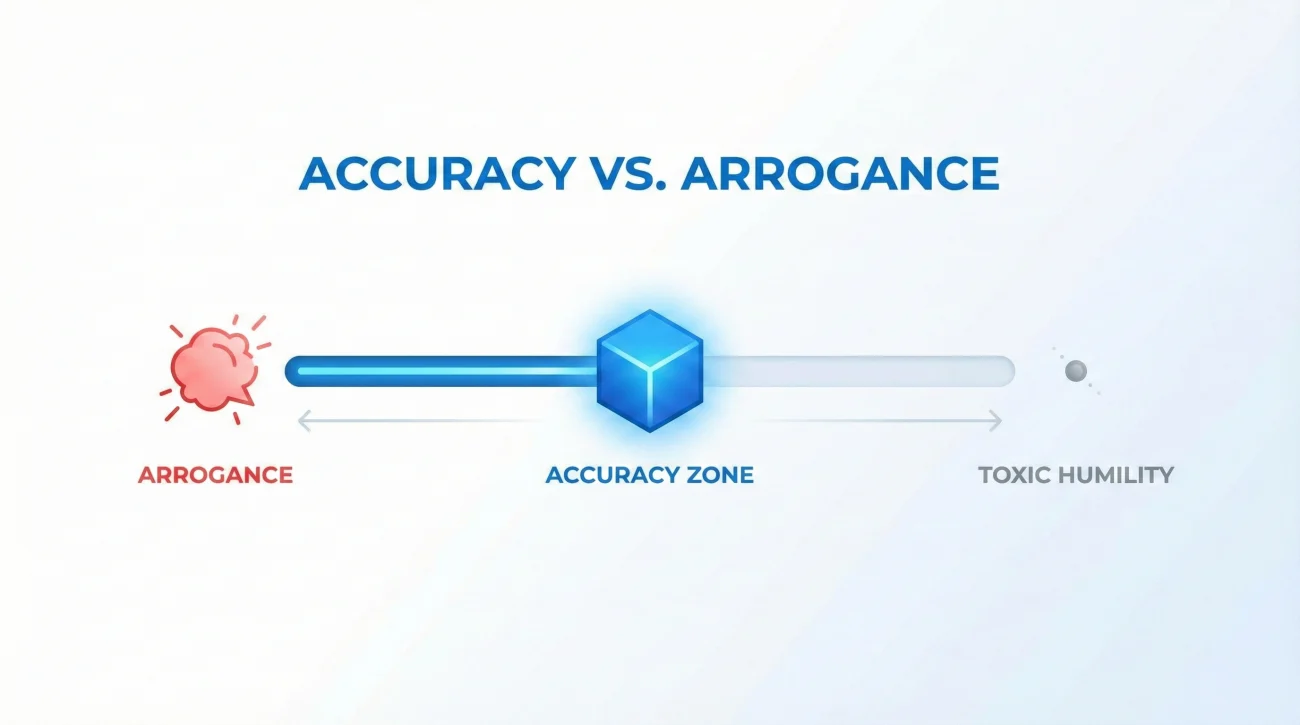
Arrogance (Subjective & Comparative)
Arrogance claims superiority without proof. It puts others down to lift the self up.
Examples: “The Best Marketer Alive,” “Guru,” “Ninja,” “Crushing the Competition.”
Verdict: Avoid. This triggers skepticism.
Accuracy (Objective & Factual)
Accuracy states what happened. It is neutral. It is data.
Examples: “Managed $5M Budget,” “Published 3 Papers,” “Certified PMP,” “10 Years Experience.”
Verdict: Embrace. Facts have no feelings. If you did it, you own it.
The Reframe: Think of your headline as a Product Label. If a jar of jam contains 50% strawberries, the label must say “50% Strawberries.” If the label says “Maybe some fruit, I guess,” it is lying. Accurate labeling helps the buyer (Recruiter) find the product (You).
The Vocabulary of Self-Sabotage: Words to Delete Immediately

Imposter syndrome leaks out through specific “minimizer words.” These words act as a shield to protect you from criticism, but they also shield you from success. Open your profile and search for these immediately.
| The Minimizer | What It Signals | The Power Swap |
|---|---|---|
| “Aspiring” (e.g., Aspiring Data Scientist) | “I am not one yet. Do not hire me.” | “Junior” or “Entry-Level” (Signals you have the skills, just early in tenure) |
| “Just” / “Only” (e.g., Just a writer) | “My work has no value.” | [Delete it completely] (“Content Writer” is a complete sentence) |
| “Enthusiast” (e.g., Cloud Enthusiast) | “I do this as a hobby, not a profession.” | “Specialist” or “Practitioner” (Signals professional application) |
| “Helping” (e.g., Helping teams…) | Vague, support-role mindset. | “Enabling” or “Driving” (Active verbs imply ownership of the outcome) |
| “Student of…” (e.g., Student of Life) | Unprofessional, lacks direction. | “Continuous Learner” (If you must include it, put it at the end) |
Strategic Scripts for the “Imposter” Archetypes
Imposter syndrome hits different people differently. Identify your archetype and use the corresponding strategy.

1️⃣ The Career Changer (“I have no experience in this NEW field”)
1. The Career Changer (“I have no experience in this NEW field”)
The Fear: You were a Teacher for 10 years, now you are a UX Designer. You feel like a fraud calling yourself a Designer.
The Fix: Transferable Authority. You are not starting from zero; you are bringing 10 years of “User Empathy” and “Communication” to design.
- ❌ Weak: “Former Teacher seeking UX Design roles | Bootcamp Grad”
- ✅ Strong: “UX Designer | EdTech Specialist | Leveraging 10 Years of Curriculum Design Experience | Wireframing & Prototyping”
2️⃣ The Junior / New Grad (“I haven’t done anything real yet”)
2. The Junior / New Grad (“I haven’t done anything real yet”)
The Fear: You have a degree but no job. You feel empty.
The Fix: Skill-Based Positioning. Your value is your potential and your hard skills (tools), not your history.
- ❌ Weak: “Recent Grad | Looking for opportunities | Hard worker”
- ✅ Strong: “Marketing Associate | Social Media Strategy & Analytics | Google Analytics Certified | B.A. Comms”
3️⃣ The Humble Expert / Cultural Barrier (“I was raised not to brag”)
3. The Humble Expert / Cultural Barrier (“I was raised not to brag”)
The Fear: You come from a culture (Asian, Nordic, etc.) where self-promotion is seen as shameful.
The Fix: Team-Centric Facts. Frame your achievements as contributions to the team or company success. It feels safer but signals competence.
- ❌ Weak: “Engineer at TechCorp” (Too quiet)
- ✅ Strong: “Senior Engineer | Contributing to Scalable Cloud Infrastructure at TechCorp | React & Node.js Ecosystem”
4️⃣ The Generalist (“I’m a jack of all trades, master of none”)
4. The Generalist (“I’m a jack of all trades, master of none”)
The Fear: You do a little bit of everything, so you feel like an expert in nothing.
The Fix: The “Operations” Umbrella. Frame your versatility as “Problem Solving” or “Operations.”
- ❌ Weak: “Admin / Marketing / Sales / I do it all”
- ✅ Strong: “Business Operations Manager | Bridging Sales & Marketing Gaps | Process Optimization & Workflow Automation”
The “Evidence-Based” Confidence Framework
When your brain says “You are a fraud,” fight back with evidence. Use this 3-step process to build a headline that feels true, not boastful.

Step 1: The “So What?” Audit
List everything you did last year. For every task, ask “So what? What was the result?”
- Task: “I wrote blog posts.”
- So What?: “Traffic increased by 20%.”
- Headline Component: “Content Writer driving 20% Traffic Growth.”
Step 2: The Third-Party Validator
If you can’t say you’re good, let others say it. Use certifications, awards, or affiliations.
- Feeling: “I’m not a real Project Manager.”
- Validator: “PMP Certified.” (PMI Institute says you are).
- Headline Component: “Project Manager | PMP | Agile Certified.”
Step 3: The Tool Shelf
Listing tools is emotionally neutral. You either know Python or you don’t. It removes the ego.
- Headline Component: “Python | SQL | Tableau | AWS.”
Case Studies: The Transformation
See how removing the “Imposter Filter” changes the perception of value.
| The Imposter Headline | The Confident Headline | The Shift |
|---|---|---|
| “Aspiring Developer | Learning React” | “Frontend Developer | React & JavaScript Specialist | Building Responsive UI” | From “Student” to “Builder.” Recruiters hire Builders. |
| “Just helping out with HR tasks” | “HR Coordinator | Onboarding & Employee Experience | Supporting 200+ Staff” | From “Helper” to “Owner.” Scale adds weight. |
| “Freelance writer looking for gigs” | “B2B Content Writer | SaaS & FinTech | SEO-Optimized Articles | Available for Q3” | From “Desperate” to “Professional Service Provider.” |
| “Experienced Manager” | “Sales Manager | Led Team to $5M ARR | Coaching & Pipeline Strategy” | From “Vague” to “High-Performance.” Numbers don’t lie. |
The 7-Day Confidence Detox Checklist
Before you publish your new headline, run it through this detox filter.
- The “Just” Check: Did I delete the word “Just”? (Yes/No)
- The Evidence Check: Can I prove every claim with a metric, certificate, or portfolio piece? (If yes, it’s not bragging).
- The “Job Description” Match: Does my headline match the job I want, or the job I have? (Dress for the job you want).
- The Specificity Check: Did I replace vague words (“Passionate”) with hard skills (“Java”)?
- The Friend Test: If a friend read this, would they say “That’s exactly what you do”?
- The “Future Self” Check: Does this headline represent the professional I am becoming?
❓ FAQ
😨 What if I claim a skill and I’m not an “expert” yet?
🤥 Isn’t “fake it ’til you make it” dangerous?
📉 I have a career gap. Should I hide it in the headline?
🌏 My culture says humility is a virtue. How do I handle this?
Final Thoughts: Give Yourself Permission
The most qualified people often have the loudest inner critic. But your LinkedIn profile is not the place for your inner critic to speak. It is the place for your Professional Advocate to speak.
You have earned your skills. You have lived your experience. You have delivered your results. Writing them down is not an act of arrogance; it is an act of ownership. Give yourself permission to be seen.
Ready to claim your narrative? Browse our industry-specific examples to see how other professionals confidently position themselves.
Don’t stop at just one headline fix. The blog is packed with more scripts, templates, and ideas you can copy.